

What Makes an Electric Flatcar a Smarter Choice for Heavy Material Transfer?
2026-05-11
When I look at how heavy materials move inside a foundry, steel plant, casting workshop, fabrication yard, or large industrial warehouse, I usually see the same problem appear again and again: the equipment is heavy, the route is repetitive, the safety risk is high, and traditional handling methods waste too much labor. That is why I pay close attention to solutions from Qingdao Kaijie Heavy Industry Machinery Co., Ltd., especially when a project needs a practical and durable Electric Flatcar for daily material transfer without turning every load movement into a difficult operation.
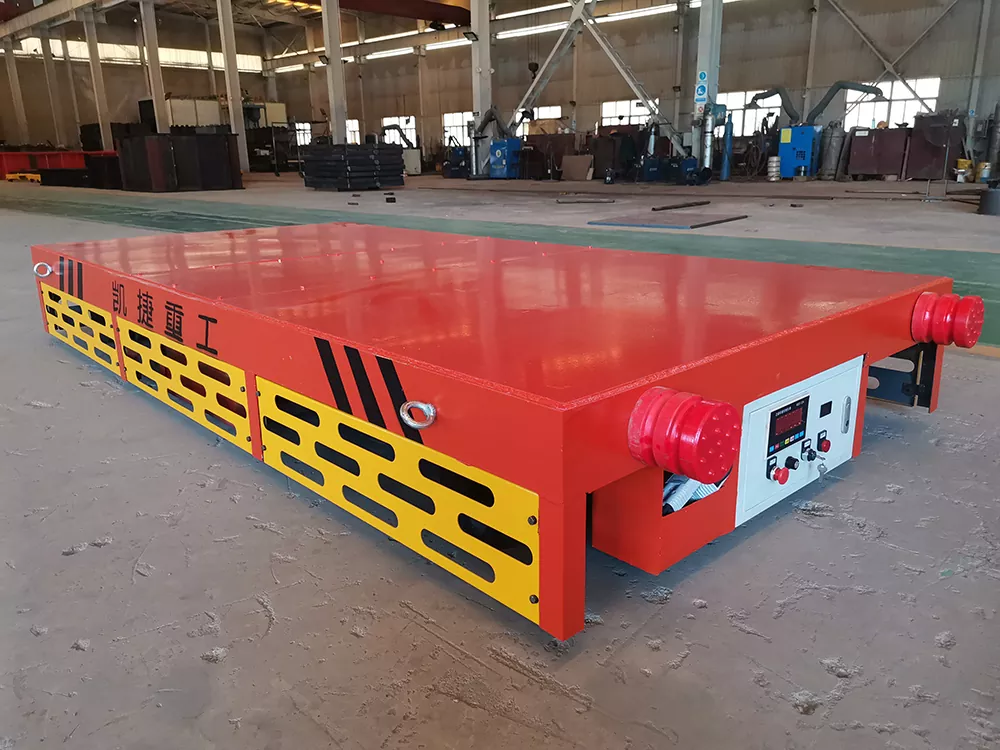
An Electric Flatcar is not just a powered platform with wheels. In real industrial work, it can become the quiet backbone of a production line. It helps move molds, steel coils, casting parts, ladles, machinery components, structural parts, and other heavy loads between fixed stations. More importantly, it can reduce the pressure on forklifts, cranes, and manual handling teams when the transport route is frequent, predictable, and load-intensive.
Why Do I Prefer an Electric Flatcar for Repeated Heavy-Duty Transport?
I prefer an Electric Flatcar in workshops where materials need to move repeatedly between production areas, storage zones, loading points, and processing stations. Forklifts can be flexible, but they also require wide turning space, skilled operators, and constant attention to pedestrian traffic. Overhead cranes are useful, but they are not always convenient for horizontal transport over longer workshop distances.
By comparison, an electric transfer flatcar offers a more stable and predictable transport method. It can follow rails or operate as a battery-powered trackless vehicle depending on the plant layout. For companies handling heavy parts every day, this matters because the goal is not only to move one load successfully. The real goal is to move hundreds or thousands of loads safely, steadily, and with fewer disruptions.
- It supports heavy loads with a low and stable platform structure.
- It can reduce dependence on forklifts for repetitive transfer work.
- It improves workshop traffic order when routes are clearly planned.
- It can be customized for rail-mounted, cable-powered, or battery-powered operation.
- It helps workers handle large parts with less physical strain.
Which Workshop Problems Can an Electric Flatcar Help Solve?
From my experience, buyers are rarely looking for a machine only because it looks advanced. They are usually trying to solve very specific production problems. A good Electric Flatcar should answer those problems directly.
| Common workshop problem | How an electric flatcar helps | Practical value for buyers |
|---|---|---|
| Heavy materials are difficult to move safely | Provides a stable loading platform and controlled movement | Reduces handling risk and improves transport consistency |
| Forklift routes are crowded or inefficient | Uses planned transfer paths for repeated movement | Improves internal logistics and reduces traffic conflict |
| Loads vary in size and shape | Platform size, structure, and steering method can be adapted | Supports different industrial materials and production layouts |
| Long-distance workshop transfer is frequent | Battery-powered or rail-powered options can match route length | Helps maintain steady movement across large facilities |
| Maintenance downtime affects output | Simple structure can make daily operation and service easier | Supports long-term use with practical maintenance planning |
How Does an Electric Flatcar Fit Different Power Supply Needs?
One reason I like the Electric Flatcar category is that it does not force every factory into one fixed solution. Different working environments need different power methods. A foundry that moves hot ladles on a fixed rail line may have different requirements from a fabrication plant that needs trackless movement between several areas.
For a planned rail route, a low-voltage rail-powered flatcar can be a practical choice. It is suitable when the transport path is stable and the workshop wants controlled movement along a defined line. For operations that need flexibility, a battery-powered flatcar may be more suitable because it is not limited by a cable route. For shorter routes with predictable movement, a cable-reel flatcar can also be considered when the working distance and cable management are appropriate.
- Rail-powered models suit fixed routes, stable lines, and repetitive transfer tasks.
- Cable-reel models work well for shorter planned distances where cable control is manageable.
- Battery-powered models offer more flexible movement and can reduce restrictions caused by fixed power lines.
- Trackless flatcars can support workshops where the route may change or where rails are inconvenient.
What Should I Check Before Choosing an Electric Flatcar?
Before choosing an Electric Flatcar, I would not start with the catalog model first. I would start with the working conditions. A flatcar that performs well in one factory may not be the best choice for another plant if the route, load, floor condition, or operating frequency is different.
Here are the details I would check before making a serious inquiry:
- Load capacity because the rated load should match the real maximum working weight.
- Platform size because oversized parts need enough support area.
- Running distance because power supply selection depends heavily on travel length.
- Rail or trackless operation because plant layout decides whether fixed movement or flexible movement is better.
- Working environment because foundries, steel mills, and general workshops may require different protection details.
- Operation frequency because high-frequency use requires more attention to motor, battery, control, and maintenance planning.
- Loading method because crane loading, forklift loading, and direct production-line transfer each need different platform considerations.
Is an Electric Flatcar Useful Beyond Foundry Applications?
Yes, I would not limit an Electric Flatcar only to foundries, even though it is highly valuable in casting and metallurgical environments. It can also support machinery manufacturing, steel structure production, mold handling, warehouse transfer, assembly line feeding, shipyard component movement, and heavy equipment maintenance areas.
The key question is whether the plant has heavy items that need to move regularly between workstations. If the answer is yes, then an electric transfer flatcar can often provide better order and reliability than temporary handling methods. It does not replace every lifting or transport machine, but it can become the dedicated transfer link between them.
For example, a crane may lift a heavy component onto the platform. The flatcar then carries it across the workshop. Another crane or workstation receives it at the destination. This division of work makes the whole process smoother, especially when the same transport route appears many times per day.
Do Buyers Gain More Than Basic Material Movement?
In my view, the real value of an Electric Flatcar is not only movement. The deeper value is process control. When a factory relies on improvised material handling, every transfer can become slightly different. One operator may choose one route, another may choose another route, and production rhythm becomes harder to manage.
A properly selected flatcar gives the workshop a more standardized transfer method. That can support better safety planning, clearer logistics flow, and more predictable production scheduling. For buyers, this means the purchase decision is not just about one piece of equipment. It is about improving the way materials move through the entire site.
| Buyer concern | Why it matters | What a suitable flatcar should provide |
|---|---|---|
| Safety | Heavy loads can create serious risks during movement | Stable platform, controlled speed, reliable braking, and suitable route design |
| Efficiency | Slow transfer affects production rhythm | Smooth operation and proper capacity for repeated transport |
| Customization | Different plants handle different materials | Adaptable platform size, power method, rail design, and control options |
| Durability | Industrial transport equipment must handle long-term workload | Strong frame, reliable drive system, and maintainable structure |
| Cost control | Handling equipment should reduce hidden labor and downtime costs | Practical operation, reduced manual effort, and efficient internal movement |
How Can an Electric Flatcar Improve Daily Production Flow?
When I evaluate a workshop, I always watch how materials move before I look at the machines themselves. A high-performance production machine still loses value if raw materials, molds, castings, or finished parts are stuck waiting in the wrong place. This is where an Electric Flatcar can quietly improve daily flow.
It can connect cutting, casting, assembly, heat treatment, storage, and loading areas in a more organized way. Instead of depending on a forklift each time a large item needs to move, the team can use a dedicated transfer system designed around the actual work route.
For many industrial buyers, this can bring several practical improvements:
- Less waiting time between production steps.
- Better use of workshop floor space.
- Lower risk of damage to heavy or valuable parts.
- Reduced operator fatigue during repeated handling tasks.
- More predictable movement between fixed production stations.
Which Details Make a Manufacturer More Reliable?
When I assess a supplier, I pay attention to whether the company understands real workshop conditions instead of only selling a standard product. Qingdao Kaijie Heavy Industry Machinery Co., Ltd. works in heavy industrial equipment fields, and that background matters because electric flatcars are often used in demanding environments such as foundries, steel-related workshops, and heavy manufacturing sites.
A reliable manufacturer should be able to discuss load capacity, power mode, travel distance, rail conditions, platform design, safety controls, and the type of materials being transported. I would also expect practical communication before production, because a flatcar should match the buyer’s layout rather than force the buyer to change the whole workshop around the machine.
Good purchasing communication should include:
- The maximum load weight and regular working load.
- The size and shape of the transported materials.
- The route length and whether the path is straight, curved, rail-mounted, or trackless.
- The working frequency per shift or per day.
- The workshop environment, including heat, dust, humidity, or uneven ground.
- The preferred control method and safety requirements.
What Makes an Electric Flatcar Worth Considering for Long-Term Use?
A machine used for internal heavy transport should not be judged only by the purchase price. I would also consider its long-term contribution to production stability. A suitable Electric Flatcar can help reduce repeated labor, improve workshop order, support safer movement, and make heavy-load transfer easier to manage over time.
For buyers who handle molds, ladles, steel parts, casting components, fabricated structures, or oversized machinery, the question is not whether heavy materials need to move. They already do. The real question is whether the current handling method is safe, efficient, and sustainable enough for future production demand.
If your workshop needs a customized material transfer solution, now is a good time to review your load capacity, route distance, platform size, and power supply needs. To discuss a suitable Electric Flatcar for your project, leave an inquiry, share your working conditions, or contact us for a practical equipment recommendation based on your real production site.