

Ozone Machine Manufacturer Guide to Reliable Air and Water Treatment
2026-10-02
Ask ten ozone machine manufacturers what 'reliable' means and you'll get ten different answers. That's a problem if you're sourcing equipment for air or water treatment where consistency is non-negotiable. LUFUTATECH takes a different route: instead of chasing peak ozone output on a spec sheet, they engineer machines that hold their performance over thousands of hours. This guide walks through the design and manufacturing details that actually matter—corona cell materials, cooling, feed gas prep, and output stability—so you can spot the difference between a machine that tests well and one that lasts. If you've been burned by drift, short-lived modules, or vague calibration claims, the next few sections will change how you evaluate your next purchase.
Ozone Dosage: The Overlooked Lever in Air and Water Treatment
Most operators fixate on contact time or generator output, yet the actual grams-per-hour of ozone entering the stream rarely gets the attention it deserves. Under-dosing leaves pathogens and trace organics untouched, while over-dosing wastes energy and accelerates corrosion in downstream piping. The sweet spot shifts with humidity, temperature, and the specific target contaminant—meaning a set-and-forget approach quietly undermines performance.
In cooling towers, for instance, a modest ozone residual of 0.05–0.1 ppm can control biofilm, but bumping that to 0.3 ppm may only yield marginal gains while tripling oxidation byproducts. Water treatment veterans learn to read indirect signals: a sudden drop in ORP, a faint bleach-like odor at the vent, or rising pressure drop across a filter. These clues often point back to an uncalibrated ozone dose rather than the equipment itself.
What makes dosage genuinely tricky is its nonlinear response. Doubling the ozone feed does not double the disinfection rate—reaction kinetics plateau and radical scavengers consume the excess. Smart facilities now log dose per unit of flow or per kilogram of COD removed, turning ozone from a blunt instrument into a tunable lever. The overlooked part isn't the chemistry; it's the discipline of adjusting dose as load and ambient conditions drift throughout the day.
What Spec Sheets Won't Tell You About Ozone Output
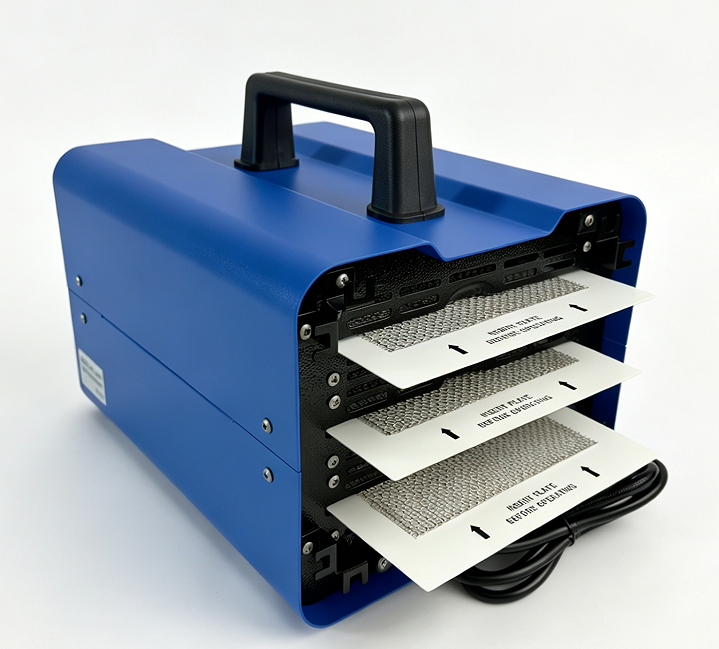
Spec sheets give you a single number, usually measured in a closed chamber with ideal temperature and near-zero humidity. But in real rooms, ambient moisture, airflow patterns, and the age of the ozone cell change actual output dramatically. A unit labeled 500 mg/h might deliver less than half that in a damp basement or a warm laundry room within minutes, not because anything is broken, but because ozone reacts with water vapor and nearby surfaces long before it reaches the space you care about.
Another omission is the decay curve. Corona discharge plates and ceramic cells start losing efficiency from their first hour of use. The first ten hours often produce noticeably more ozone than hour fifty, even though the fan still spins and the indicator light glows the same. Manufacturers rarely publish how fast output drops, so you can be left running a machine that has quietly fallen below the level you actually need for odor control or sanitation.
Placement matters just as much. A generator rated at 400 mg/h in free air might only deliver a fraction of that inside a closet packed with clothes or a car with fabric seats that absorb ozone. The spec number is a laboratory value, not a field promise. If you are sizing a unit for a room, start by cutting the advertised output in half, then adjust for ventilation and material load. Otherwise you will run the machine twice as long and still wonder why the smell will not budge.
How Feed Water Quality Shapes Ozone Reaction Efficiency
Feed water quality sets the baseline for ozone reaction efficiency in ways that often go unnoticed until performance drifts. The ratio between direct molecular ozone attack and indirect hydroxyl radical pathways depends heavily on pH, alkalinity, and the presence of dissolved organic matter. In low-alkalinity waters with moderate pH, ozone tends to persist longer, allowing direct oxidation of target contaminants. As carbonate and bicarbonate concentrations rise, they scavenge hydroxyl radicals quickly, shifting the process toward slower, more selective molecular reactions. This shift can reduce overall oxidation rates for recalcitrant compounds while inadvertently extending ozone residual in the contactor.
Natural organic matter plays a dual role. It consumes ozone through rapid reactions, inflating the apparent ozone demand and leaving less oxidant available for micropollutants. At the same time, some NOM fractions can promote radical chain reactions under UV or high pH, sometimes boosting degradation of certain pollutants. Suspended solids and turbidity complicate matters by shielding target molecules or creating local concentration gradients that slow mass transfer. Temperature also matters: colder water holds more ozone but slows reaction kinetics, while warmer water speeds up reactions but reduces ozone solubility, forcing operators to recalibrate doses seasonally.
Practical control of ozone efficiency therefore starts with understanding the raw water matrix, not just the target compound. Pre-treatment steps like coagulation, sedimentation, and filtration remove a large share of ozone-demanding substances, allowing the same ozone dose to achieve higher log removals or shorter contact times. Real-time monitoring of pH, UV absorbance, and alkalinity can guide dynamic ozone dosing, reducing wasted oxidant and minimizing bromate formation potential. When feed water quality fluctuates due to rainfall, algal blooms, or industrial discharges, a flexible ozone strategy becomes essential rather than a fixed setpoint.
The Maintenance Rituals Behind Decade-Long Ozone Cell Life
Most ozone cells die early from neglect dressed as routine care. The actual ritual is less about chemical baths and more about friction control: every two weeks, the anode contact is burnished with a dry microfiber pad, not sandpaper, and then wiped with 99% isopropyl alcohol until no gray residue transfers. That single habit stops the slow build-up of oxide layers that quietly raise resistance and force the power supply to work hotter.
Water quality is the next quiet killer. Instead of rinsing the cell under tap water, long-term operators keep a squeeze bottle of distilled water and a separate vial of citric acid solution. A thirty-second flush with distilled water after each ozone session removes mineral film before it bakes on. Only when the inner quartz sleeve turns hazy—typically every four to six months—does a five-minute soak in warm citric acid come into play, followed by two distilled rinses and a full air dry on a lint-free cloth.
The last ritual is environmental. Ozone cells are stored capped, with desiccant packs replaced at the start of each month, and never in a damp utility closet. Voltage readings are logged after every tenth cycle; a drift of more than 0.3 volts from baseline triggers an early inspection instead of waiting for failure. These small, repeated gestures add up to a decade of service because they treat the cell as an electrode with history, not a disposable cartridge.
Choosing Ozone Concentration for Specific Contaminant Loads
Determining the right ozone dose starts with a clear inventory of what you are actually treating. Instead of relying on generic tables, pull a recent water analysis and list each contaminant, its current concentration, and the target level you need to hit. Then work through the stoichiometric demand for direct oxidation reactions, but leave room for the indirect pathway: ozone decomposes into hydroxyl radicals, which often do the heavy lifting on recalcitrant organics. A practical approach is to run a bench-scale demand test with a range of ozone doses, measuring residual ozone after a fixed contact time. This quickly reveals the inflection point where additional ozone starts producing a measurable residual rather than being consumed immediately.
For mixed contaminant loads, avoid the trap of summing individual ozone demands blindly. Some compounds shield others from oxidation, while natural organic matter can scavenge radicals and inflate the apparent demand. A better tactic is to spike the actual water matrix with the contaminants of concern and titrate ozone until you see a consistent breakthrough. If you are dealing with pathogens, pair the ozone residual and contact time using Ct tables, but remember that turbidity and temperature shift the required values. When targeting trace organics like pesticides or pharmaceuticals, the dose often needs to exceed the simple stoichiometric ratio by a factor of two to five because of competing reactions.
Field adjustment matters as much as the initial calculation. Start with a conservative dose based on jar tests, then monitor the residual ozone at two or three points along the contact chamber. If the residual crashes before the midway point, the load is higher than expected or short-circuiting is occurring. Conversely, a strong residual at the outlet may mean you are over-dosing, which wastes energy and can form bromate in bromide-containing waters. Log the dose, contact time, water temperature, and contaminant removal for each batch, and build your own site-specific response curve. That curve will serve you better than any generic guideline when the next load spike hits.
Manufacturing Details That Separate Reliable Ozone Machines from the Rest
Look past the housing and the real differences become obvious. Reliable ozone generators use corona discharge cells built around precision-machined ceramic or quartz dielectrics, not thin metal plates that warp after repeated thermal cycling. The electrode gap is held to tight tolerances—often within a few hundredths of a millimeter—so output stays consistent instead of drifting as the unit heats up. Cheaper designs rely on glue and friction fits; better ones use compression seals and thermal gaskets that keep moisture out of the high-voltage path.
Internal wiring tells you a lot too. In dependable units, high-voltage leads are silicone-insulated and routed away from sharp edges, with strain relief at every termination. Circuit boards get conformal coating to handle humid environments, and the transformer is potted or vacuum-sealed to prevent corona discharge inside the chassis. You won't see exposed solder joints acting as antennas for arcing; instead, connections are either crimped, soldered, and then covered with heat-shrink, or they're built into sealed modular connectors that can be replaced without rewiring the whole board.
Finally, manufacturing consistency separates the long-term performers. Reliable factories calibrate each ozone cell against a reference gas analyzer and mark the measured output on the unit, or at least bin the cells by output range. They run every assembled machine for a burn-in period to catch early failures, then re-check ozone concentration and leak current before packing. That kind of end-of-line testing costs more, but it's why some machines still hold their rated output after thousands of hours while others fade within months.
FAQ
Look beyond flashy specs. Verify whether the manufacturer shares third-party test data for ozone output and lifespan under real-world conditions. Also check if they offer clear guidance on sizing the unit for your water or air volume, since undersized machines are a common reason for disappointing results.
Ozone is a strong oxidizer that breaks down many odor-causing compounds, bacteria, and some chemicals. In water, it can neutralize iron, sulfur, and microbial contamination without leaving chemical residues. In air, it reacts with smoke, mold spores, and volatile organics, but proper ventilation and exposure time matter just as much as the generator itself.
No. Most manufacturers recommend running ozone treatment in unoccupied spaces and allowing enough time for ozone to revert to ordinary oxygen before people or pets return. The exact safe re-entry window depends on output level, room size, and airflow, so a trustworthy manufacturer will provide specific operating instructions instead of vague claims.
A reliable manufacturer typically designs the corona discharge cell or electrode stack in-house and tests each unit before shipping. They also offer replacement parts, repair guidance, and a realistic warranty that covers the ozone-producing component. If a company cannot explain how their machine maintains output after hundreds of hours, that is a red flag.
Most residential and light commercial units need the ozone plate or cell cleaned every few months, depending on humidity and dust. Some machines use self-cleaning or replaceable plates. The manufacturer should tell you the expected plate lifespan in hours and make replacements easy to order. Ignoring maintenance leads to a gradual drop in output that users often mistake for equipment failure.
Some portable units can do both if they include an air dryer and a diffuser stone or venturi for water injection. However, dedicated water treatment systems are usually more efficient because water requires higher ozone concentration and longer contact time. Ask the manufacturer for specific flow rate and contact tank recommendations before buying a dual-purpose unit.
Look for third-party electrical safety marks like UL or CE where applicable, plus test reports showing ozone output and any byproduct levels under typical operating conditions. Reputable manufacturers may also comply with standards for ozone in occupied spaces, but the key is that they can back up their numbers with dated test documents. Avoid companies that only mention internal quality checks without data.
The difference usually comes down to the quality of the ozone-producing cell, the efficiency of the power supply, and whether the output is measured accurately. Cheaper units may use thin ceramic plates that degrade quickly or lack a proper air dryer, which reduces effective ozone in humid environments. A higher upfront cost can be justified if the manufacturer proves longer plate life and stable output over time.
Conclusion
Most ozone treatment failures trace back to dosage, not hardware flaws. The right ozone dose depends on contact time, water chemistry, and the actual contaminant load—yet many operators rely on nominal output figures that ignore dissolved versus off-gas losses. Feed water quality quietly shapes reaction efficiency too: hardness, pH, and organic scavengers can consume ozone before it reaches the target microbe or pollutant. A machine that performs well on clean test water may stumble in a real plant with iron or manganese present. The overlooked lever is often the simplest: measure residual ozone at the point of use, then adjust gas flow or concentration instead of chasing higher generator wattage.
Long-term reliability comes from manufacturing choices and maintenance habits that spec sheets rarely mention. Corona discharge cells need dry, filtered feed gas and periodic cleaning of dielectrics; ignoring these rituals shortens cell life well below the decade mark. For targeted contaminant loads, a lower concentration with longer contact time can outperform a high-concentration blast, especially for stubborn compounds like biofilm or chloramines. Finally, reliable manufacturers separate themselves through welded fittings, thicker ceramic tubes, and honest derating curves rather than inflated peak numbers. These details—not marketing language—determine whether an ozone machine treats air and water consistently for ten years or fades after eighteen months.
Contact Us
Contact Person: Paul Luo
Email: [email protected]
Tel/WhatsApp: 0086-19966314501
Website: https://www.lufutatech.com