

Lightning Strike Current Sensor Company Innovations for Power Grid Safety
2026-11-16
Every lightning strike tests the grid in ways most monitoring systems never see. Xiasen is changing that with lightning strike current sensors built for the messy reality of surge events. Instead of treating a strike as just another data point, these sensors capture the fast transient details that determine whether protection schemes actually work. This post explores the engineering behind that shift and why it matters for power grid safety.
A Sensor's First Flash Captures Current Where the Strike Begins
Lightning rarely gives away its opening move. The first measurable signal often arrives as a faint current surge inside the cloud, long before the bright return stroke reaches the ground. A newly deployed sensor aims its trigger at that initial flash, locking onto the earliest burst of current exactly where the strike starts rather than where it later becomes visible.
The instrument pairs a fast optical detector with a wideband current probe mounted close to the likely attachment point. When the leader begins to form, the sensor records the raw onset within microseconds, capturing the sharp rise in current that precedes the main channel illumination. That first flash is not just a timing marker; it carries the local charge distribution and the precise path the strike will follow.
Because the sensor is positioned to catch this onset directly, the recordings bypass the smoothing and reflections that often distort measurements taken farther down the channel. Engineers can then compare the initial current pulse with later return-stroke peaks, uncovering how a strike chooses its route in the first few instants. The result is a clearer picture of the formation phase, one that standard lightning mapping systems tend to miss.
Towers That Talk Back After Every Thunderstorm
After the last thunderclap rolls away, the tall steel towers don't fall silent. They begin to answer in a low, irregular language of ticks, sizzles, and deep metallic groans. Moisture lingers on the insulators and crossarms just long enough to create thin conductive paths, releasing small pockets of trapped charge as faint white-blue sparks. At the same time, the cooling metal contracts unevenly, and the joints settle with short creaks that sound almost deliberate.
The effect is strongest on high-voltage transmission towers and broadcast masts, where the structure itself becomes a loose instrument played by wind and leftover electricity. Water films bridge tiny gaps, guiding static toward the ground in bursts that last only a fraction of a second. Each discharge is too small to see from a distance, but up close it gives the impression that the tower is muttering to itself while it shrugs off the storm.
Locals often read these sounds as a sign that the weather is already changing. When the metal starts to murmur after heavy rain, the air is usually drying out and the last stored energy is bleeding away. There is no warning siren or signal, just the tower exhaling the storm in its own quiet, electric voice.
Rethinking Calibration for Current That Rises in Microseconds
Most calibration routines still treat current sensing as a nearly static problem: apply a known DC or low-frequency sine, compare the reading, and store a correction factor. That comfortable picture falls apart when the edge of interest lasts only a few microseconds. Parasitic inductance in a shunt, the finite settling time of a probe amplifier, and even the physical loop area of the test leads stop being second-order details and start writing the shape of the measured waveform.
A more useful approach is to calibrate against a known step, not a known amplitude alone. A fast reference edge with a controlled rise time exposes the full response of the sensing chain, including overshoot, propagation delay, and any resonance that a steady-state check would hide. From that captured step response the instrument or the data-reduction path can be corrected in the time domain, so the reported current tracks the actual rise instead of the probe's opinion of it.
That shift also changes what belongs on the calibration bench. Short, rigid connections, low-inductance shunts, and a defined return-current path matter more than the precision of the source in the traditional sense. The point is not to make a perfect microsecond pulse; it is to know precisely how far from perfect it is and to keep that error small enough to ignore for the measurement at hand.
When Peak Current Isn't Enough for Grid Protection
In many industrial and utility installations, protection settings built around a fixed peak current threshold assume that fault magnitudes will always exceed normal load peaks by a clear margin. That assumption breaks down in networks with high penetration of inverter-based resources, long cable runs, or heavily compensated lines. A fault can draw only slightly more current than a large motor start or a sudden load transfer, leaving the relay with no reliable margin to trip without risking nuisance outages.
When the current magnitude sits in that ambiguous middle zone, time becomes the more useful variable. Protection schemes start to lean on rate-of-change measurements, sequence component ratios, and directional comparisons that do not depend on a single high-current spike. A slowly evolving high-resistance fault, for instance, may never reach the old peak-current pickup, but it still creates a distinctive phase shift and a persistent negative-sequence signature.
The practical shift is to design protection around the shape and behavior of the event rather than just the height of the current waveform. This means combining undervoltage supervision, impedance trajectories, and even traveling-wave detection in places where the traditional peak-current logic leaves too much dead space. Grid protection becomes less about waiting for a larger spike and more about recognizing that the system is already behaving in a way that normal loads do not.
From Streamer to Return Stroke Without Losing the Signal
Capturing the transition from streamer to return stroke usually means accepting a short blind window just when the channel changes character. The streamer phase produces faint, scattered bursts, while the return stroke arrives as a violent surge. If the recording path switches gain or re-arms a trigger at that moment, the exact connection between the two stages disappears. Keeping the signal intact requires a sensor chain that stays live through the entire evolution rather than restarting when the bright pulse finally appears.
One practical approach is to run parallel front ends with different sensitivities into a shared circular buffer. The low-gain path handles the return stroke’s peak without clipping, while the high-gain path preserves the weak streamer pulses that precede it. A fast level detector marks the return stroke, but the buffer already holds the prior milliseconds, so the record begins before the trigger and continues through the main stroke without a gap. The trick is not faster triggering alone; it is making sure nothing in the chain resets, saturates, or filters out the very signal you need to keep.
Field systems add another layer of difficulty because long cable runs and nearby interference can smear the sharp edge of the return stroke. Shielded lines, optical links, and careful grounding help maintain the waveform shape from the antenna or field mill to the digitizer. When the electric field, optical flash, and magnetic pulse are time-aligned on the same record, the streamer-to-return-stroke transition remains visible as a continuous event instead of two disconnected snapshots. That continuity is what turns a triggered capture into a usable observation.
Making Sensors Tough Enough for the Next Hundred Strikes
Most impact sensors are rated for the first hit, not the ninety-ninth. The real challenge isn’t surviving a single dramatic overload; it’s the slow buildup of micro-cracks in solder joints, delamination between bonded layers, and tiny shifts in the sensing element that quietly distort the output long before the package fails.
Making a sensor that can take a hundred strikes takes more than a thicker housing. Designers now add strain relief cuts around the transducer, float the electronics on damping adhesives, and select lead-free alloys that resist work hardening. Each of these choices redirects shock energy away from the most fragile part of the circuit instead of simply trying to absorb it.
The test rig changes too. Units are mounted to pneumatic hammers or repetitive impact stations and checked after every ten cycles. Baseline resistance and capacitance often drift before any visible cracking appears, so the pass threshold is tied to electrical stability rather than whether the casing still looks intact.
FAQ
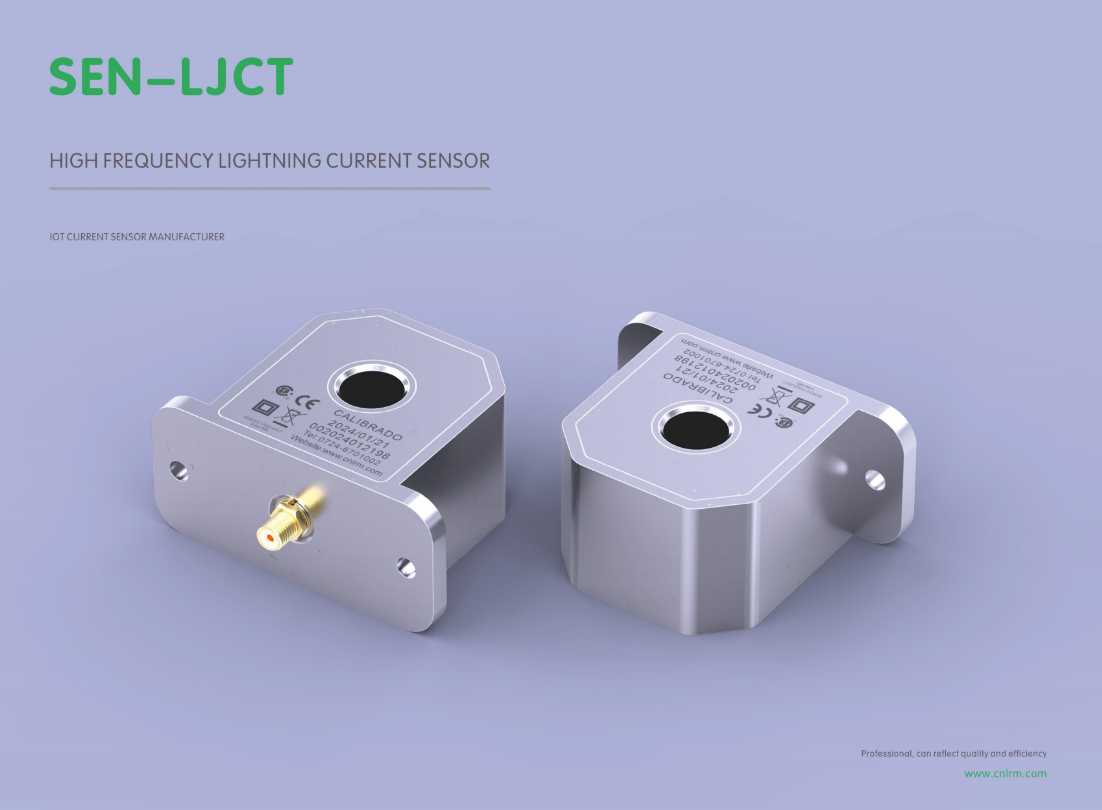
Rather than relying on iron-core transformers that saturate under extreme fault currents, the company uses a non-magnetic Rogowski coil paired with a hardened integrator. That lets the unit track a 200 kA strike without losing waveform fidelity, and the split-core housing can be clamped onto a live conductor without an outage.
Each strike is time-stamped and compared against the line's basic insulation level. If the captured peak current and charge transfer cross a preset threshold, the control room gets an alert with the pole ID and the waveform, so crews can prioritize spans that actually absorbed a damaging surge instead of patrolling the whole corridor.
Yes. The sensing head has no direct electrical contact with the conductor and the electronics are shielded behind a grounded enclosure with gas discharge tubes on the signal path. Even a direct tower hit typically leaves the sensor operational, which is the point: it has to be the last instrument standing.
Besides peak current and rise time, it returns charge transfer, specific energy, polarity, and a high-resolution waveform sampled fast enough to distinguish a first return stroke from a subsequent one. That data is packaged in a compact binary format and sent over fiber or the utility's existing SCADA radio.
Fast rise times excite different failure modes than slow tails. A stroke with a steep front can flash over insulators before a surge arrester even begins clamping, so knowing the di/dt helps engineers model insulation stress and adjust protection coordination for the lines that show the sharpest pulses.
They combine impulse generators that recreate standardized 10/350 µs and 8/20 µs waveforms with field data from instrumented towers. Over time, the accumulated records are used to refine the sensor's transfer function, so the published uncertainty band is based on actual strike statistics rather than lab tests alone.
The sensors are designed for hot-stick installation on conductors or shield wires, with no need to cut, splice, or de-energize the line. Power comes from a small current transformer harvesting energy from the line itself, so there is no separate solar panel or battery to maintain.
They are testing a mesh network where multiple sensors share strike signatures within milliseconds, allowing a substation controller to localize the strike point by time-difference-of-arrival. Early results suggest it can narrow the damage zone to within one or two spans, which could cut patrol time sharply.
Conclusion
Most lightning monitors only capture a strike after it has already surged through a structure, but this company's sensor is designed around the first flash, recording current at the initiation point before energy spreads into the tower and ground network. That shift in placement changes what utilities can actually see. Calibration has been rebuilt for waveforms that climb in microseconds rather than milliseconds, and the signal path holds together from streamer formation through the return stroke without the blanking or saturation that usually erases the most violent phase. Because peak current alone misses how fast the wavefront moves and how long it lingers, the sensor logs the full shape of the event, giving protection engineers a clearer basis for relay settings and insulation coordination.
After each thunderstorm, the hardware does not just sit silent; it transmits event data from individual towers, so crews know which structures took a hit and how hard. That feedback loop turns a scattered collection of readings into a practical maintenance map. Durability is treated as a design requirement rather than an afterthought, with the sensing elements built to survive repeated thermal and mechanical shock across a lifespan that can include a hundred or more direct attachments. The result is a grid protection tool that works at the speed of the actual phenomenon and keeps reporting long after older instruments would have failed.
Contact Us
Contact Person: Liu Mengyang
Email: [email protected]
Tel/WhatsApp: 8618727589233
Website: https://www.cnlrm.com/en/