
Equestrian Breeches Manufacturer Insights: Crafting Premium Riding Apparel for Every Discipline
2026-06-18
Discover the artistry behind OpeEquestrian breeches, where precision tailoring meets the demands of every riding discipline. Whether you’re perfecting dressage movements or tackling cross-country courses, the right apparel makes all the difference. In this post, we pull back the curtain on the craftsmanship and innovation that set OpeEquestrian apart, giving you a glimpse into what truly defines premium riding gear.
How We Source Performance Fabrics That Move With the Rider
Every fabric we choose starts with a simple question: does it enhance the connection between horse and rider? We're not interested in trends that fade after one season. Our sourcing team spends months testing materials across disciplines—from dressage arenas to cross-country courses—to understand how a textile behaves during extended trot sets, sudden shifts in balance, or the subtle half-halt. If it can't keep up with the rider's micro-adjustments, it never makes the cut.
That obsession leads us to suppliers who think like engineers rather than fashion houses. We partner with mills that weave durability into the very structure of the yarn, creating four-way stretch that recovers instantly without sagging. Moisture management is built into the fiber, not sprayed on as a coating, so the cooling effect endures after countless washes. And because riders feel every seam, we use flatlock construction and targeted compression zones developed through rider feedback—not just lab data.
Before any fabric earns a spot in our collection, it's ridden in. Hard. Our test riders log hours in rain, humidity, and dusty arena conditions, giving us unfiltered notes on breathability, chafe resistance, and that elusive second-skin feel. That raw, real-world loop shapes every yard we source, ensuring that when you move, your gear moves with you—not against you.
Design Details That Separate Premium Breeches from the Rest
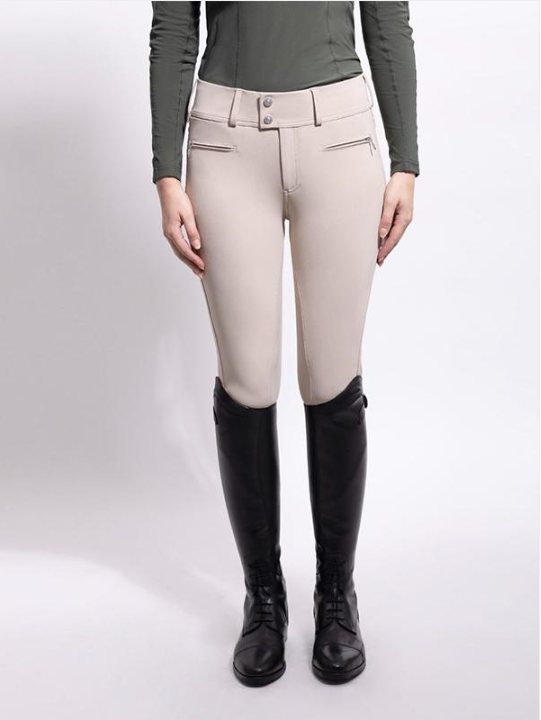
The first thing you notice about truly premium breeches is the fabric. It’s not just about durability; there’s a subtle give that moves with you, resisting pilling and sagging even after months in the saddle. High-grade technical weaves manage moisture without feeling clammy, something mass-market options rarely get right. This isn’t the kind of material you find on a clearance rack—it’s chosen for how it holds shape through a long day of training.
Turn them inside out, and the differences become more pronounced. Seams are flatlocked and reinforced, running along stress points without bulk. The seat—whether full or knee patch—often uses a tactful silicone print that provides grip without trapping heat. On cheaper pairs, you’ll see generic patches or stiff rubbery applications that peel after a few washes. Premium versions nail that balance between stickiness and breathability.
Then there’s the waistband. A wide, contoured band with a secure but gentle closure makes a huge difference. No rolling, no digging in when you’re leaning forward. Some integrate a subtle grip strip on the inside, so your shirt stays tucked. It’s these small, almost invisible decisions—like the way pockets are hidden along a seam rather than added as an afterthought—that elevate a riding breech from functional to phenomenal.
Comfort Engineering: Beyond Basic Stretch and Breathability
Modern comfort engineering digs much deeper than the surface-level promises of stretchy fabrics and airflow. It’s about how a garment quietly adapts to your body’s micro-movements throughout the day, distributing pressure away from sensitive zones and preventing the subtle buildup of friction that leads to irritation long before you notice it. Materials are now engineered at the fiber level to respond dynamically—some soften with body heat to conform to your shape, while others stay slightly rigid where you need subtle support, creating a sensation that’s less like wearing clothing and more like a second skin that actually anticipates how you move.
Moisture management has also evolved past simple wicking. Today’s smart textiles actively pull vapor away before it condenses into liquid sweat, using hydrophilic and hydrophobic zones patterned across the inside face of a garment. This keeps the microclimate next to your skin remarkably stable, even when you shift from a cool office to a crowded train. Temperature regulation often comes from phase-change materials that absorb, store, and release heat at precise thresholds—mimicking the way your body naturally cools itself, but with none of the damp chill that traditional performance fabrics can leave behind.
And then there’s the quiet ergonomic intelligence designers rarely talk about: the strategic omission of seams across high-contact zones, the mapped zones of density in knitwear that flex differently across your shoulders versus your lower back, and the way a single garment might balance compression and freedom so you never feel restricted reaching overhead or crossing your arms. These refinements don’t scream for attention, but they’re the true markers of engineering where you stop cataloguing features and simply forget you’re wearing anything at all.
Built to Last: Reinforcements Where Riding Puts the Most Stress
Every ride pounds the saddle rails, stresses the handlebar clamp, and twists the frame at its highest leverage points. We studied exactly where fatigue cracks and premature wear begin, then layered extra material only there—not everywhere, because mindless overbuilding just adds dead weight. The result is a chassis that feels alive and responsive under hard pedaling, yet shrugs off abuse that would sideline lesser bikes.
Around the bottom bracket and chainstays, you'll find precisely sculpted gussets that channel power without bulking up. The downtube gets a subtle but strategic ribbed profile where impact loads from rocky descents concentrate. Even the seat cluster receives a forged insert that spreads clamping force evenly, preventing the micro-slippage that eventually chews through standard seat tubes. These aren't cosmetic add-ons—they're functional armor placed by analyzing hundreds of broken frame reports and warranty claims.
Riders often notice the steering precision first. By reinforcing the head tube junction asymmetrically—stouter on the side that takes the brunt during hard cornering—we kept the front end tracking true without the wooden feel of a simple thick-walled tube. The dropouts and axle interfaces use cold-forged sleeves that triple the threads' service life, so you can remove and reinstall wheels almost endlessly without worrying about stripped engagement. Every reinforcement has a story, and every story starts with a rider pushing harder than the design brief ever imagined.
Tailoring Fit for Different Disciplines—From Dressage to Cross-Country
In the precise arena of dressage, every millimeter of saddle fit translates directly to the horse's ability to perform collected pirouettes and fluid transitions. The panels need to mirror the horse's back contours exactly, with thin, dense flocking that ensures the rider's weight distributes without hotspots, so subtle seat aids pass through clearly. Meanwhile, the flap cut drops straight and long to accommodate a deep leg position, but it's the twist—that narrowest part of the saddle between the thighs—that gets sculpted to let the rider's inner leg lie effortlessly close, a detail that can make or break a test's harmony.
Shift to the cross-country phase, and the concept of fit becomes almost a contradiction: it must be secure yet liberating. The saddle's front arch and pommel lower and widen to give the horse's shoulders full rotational reach over massive table jumps, while the seat itself shortens and flattens, encouraging the rider to hover above the panels in a two-point position. Stirrup bars are set slightly back, pulling the leg under the body for shock absorption at speed, and materials trade dressage's supple leather for grippy, weather-resistant synthetics that cling to a sweaty horse mid-gallop without rubbing—a balletic balance between freeing the animal and anchoring the rider when seconds count.
Even the so-called 'contact tack' is reimagined between disciplines. A dressage girth, with elastic on both ends and carefully shaped cutouts behind the elbows, allows the ribcage to expand as the horse engages deeply, while a cross-country girth might ditch the elastic entirely for a non-stretch core and attach a martingale to prevent the saddle from sliding backward over undulating terrain. These aren't just different models; they're unique geometries that define how a rider feels every stride, from the contained energy of a piaffe to the raw momentum down a drop into water.
Ethical Manufacturing Without Compromising on Quality
True ethical manufacturing isn’t about ticking boxes—it’s woven into every decision, from sourcing raw materials to the final stitch. We’ve seen firsthand that when artisans are paid fairly and work in safe, supportive environments, their pride and precision naturally elevate the products they create. It’s not charity; it’s a quality strategy. By partnering with workshops that uphold labor rights and investing in long-term relationships, we ensure consistency and attention to detail that anonymous factories rarely match.
Maintaining high standards requires transparency, so we personally audit every facility, not just for compliance but for the small things—proper lighting at workstations, ergonomic tools, and respectful collaboration. These details translate directly into our bags and accessories: flawless stitching, durable hardware, and carefully aligned patterns. We also source premium, low-impact materials, proving that sustainability and luxury can coexist. The result is a collection that feels good to carry in every sense, without any compromise on endurance or aesthetics.
FAQ
The best breeches often combine natural and synthetic fibers to balance comfort, stretch, and durability. Cotton offers breathability, while synthetic blends like nylon or spandex add flexibility and shape retention. Many premium options now incorporate technical fabrics with moisture-wicking properties, such as those derived from athletic wear, to keep riders dry during intense sessions. You'll also see silicone or knee patches for grip, chosen for their ability to hold without restricting movement.
Discipline dictates design. For dressage, breeches are typically full-seat with a suede-like or silicone grip that extends down the leg, providing stability in the saddle. Jumpers often prefer knee-patch breeches for closer contact and freedom over fences. For eventing or endurance riding, lightweight, breathable materials and strategic ventilation become priorities. Western riders might seek denim-like durability with hidden stretch. Each style is engineered to support the specific posture and demands of the sport.
Beyond fabric quality, look for ergonomic seems that reduce chafing, a waistband that stays in place without pinching, and thoughtful panel construction that moves with the body. Premium breeches often have reinforced stitching in high-stress areas, UV protection for outdoor training, and subtle details like seamless sock bottoms or phone pockets. The true test is how the garment performs over hours of riding—no bunching, no slipping, and no distraction.
Modern manufacturing leverages laser cutting for precision, seamless knitting technology, and 3D body scanning for pattern development. These advancements allow for athletic fits that were impossible with traditional cut-and-sew methods. Some facilities now use ultrasonic bonding to create smooth, durable seams. The integration of smart textiles is also on the rise, with prototypes monitoring muscle exertion or heart rate. Such innovations mean today's breeches are less like tailored pants and more like performance gear.
Yes, many specialized manufacturers offer customization from fabric selection to pattern adjustments. A rider with a longer leg or a particular seat-bone width can have breeches cut specifically for them. Beyond measurements, you can choose the type and placement of grip patches, add extra reinforcement, or select colors. Some companies even analyze a rider's motion to optimize stretch zones. This tailored approach ensures that the apparel works with the rider's body, not against it.
Fabric tech is central. Moisture management systems pull sweat away, keeping the skin dry and preventing chills in colder weather. Compression panels can reduce muscle fatigue and improve circulation. Water-resistant and stain-repellent coatings are common on breeches worn around stables. There's also a push toward sustainable materials, like recycled synthetics and biodegradable fibers, without compromising performance. Essentially, the fabric is the engine of the breech—it determines comfort, durability, and function.
Caring for performance breeches goes beyond tossing them in the wash. Always close zippers and turn them inside out to protect grip patches. Use cold water and a gentle cycle, and skip fabric softeners—they can clog moisture-wicking pores. Air drying is best to maintain elasticity and prevent synthetic fiber breakdown. For stubborn stains, pretreat gently. With proper care, a good pair can withstand countless rides, washes, and barn chores without losing its shape or grip.
Fit is everything because any wrinkle or slip can cause friction, leading to discomfort or even sores during long rides. A perfect fit moves as a second skin, allowing the rider's leg to communicate clearly with the horse. Manufacturers achieve this through anatomical paneling, multi-directional stretch fabrics, and extensive wear testing. They often use body-angle mapping to ensure the breech bends where the body bends. The result is a garment that feels almost invisible in the saddle.
Conclusion
Equestrian breeches have to perform under conditions where the bond between horse and rider is tested with every stride. Top-tier manufacturers begin by sourcing technical fabrics that provide true four-way stretch, allowing the material to move as an extension of the rider’s body rather than resisting it. These fabrics are chosen not just for give, but for gentle compression and consistent breathability—keeping muscles supported without trapping heat. Yet fabric alone isn’t enough; a premium pair separates itself through considered design: flatlock seams that vanish against the skin, silicone grip patterns placed precisely where leg contact matters most, and waistbands that dip lower at the front to prevent bunching in the saddle. It’s this integration of fabric intelligence and anatomical patterning that creates a truly unobtrusive riding experience.
Durability is engineered directly into areas that suffer repeated friction—inner knees, seat, and cuff edges are reinforced with abrasion-resistant panels, often using bonded overlays rather than bulky stitches. Crucially, fit is never generic. A dressage rider’s need for a tall, elegant rise and discreet grip differs sharply from the cross-country jockey who demands a closer, more compressive cut that won’t snag on branches. Leading producers pattern these variations as distinct garments, not mere size adjustments. Underpinning all of this is an ethical production framework: skilled workers operate in safe, clean facilities using sustainably sourced materials, proving that quality need not be sacrificed for responsible manufacturing. From sourcing to final stitch, the goal remains crafting apparel that moves with the athlete—no matter the discipline.
Contact Us
Contact Person: Keven Tong
Email: [email protected]
Tel/WhatsApp: +86 18666477707
Website: https://www.ope-technology.com