

China Thermoforming Die Making Equipment Key Technologies and Manufacturing Insights
2026-08-23
Behind every perfectly formed thermoformed product lies a complex interplay of precision tooling, material science, and manufacturing expertise. In China, the production of thermoforming dies has evolved rapidly, yet many industry professionals still struggle to identify the key technologies that separate high-performance equipment from the rest. ADEWO, a leader in the field, brings these critical insights to light. In this blog, we delve into the core technologies shaping China's thermoforming die making equipment and reveal the manufacturing strategies that deliver consistent quality. Whether you're evaluating equipment options or refining your production processes, understanding these fundamentals is no longer optional—it's essential.
What Five-Axis Machining Brings to Thermoforming Die Accuracy
Five-axis machining eliminates the need to reposition a thermoforming die blank between setups. With three-axis equipment, deep cavities or steep sidewalls often require multiple clamping angles, and each shift introduces small alignment errors. By keeping the workpiece fixed while the cutting head tilts and rotates, five-axis machines preserve the exact spatial relationship between the mold cavity, core, and cooling channel inlets. This single-setup approach is particularly valuable for multi-cavity thermoforming tools where a few microns of drift can cause uneven wall thickness in the final parts.
The ability to angle the cutter also changes how surfaces are finished. Instead of using long, slender tools that deflect under load, operators can position a shorter, stiffer cutter at an optimal lead angle to the surface. This reduces chatter marks and tool push-off, which directly improves dimensional stability across the die. The result is a more consistent surface profile that needs less manual polishing, a step that often erases carefully machined geometry if done aggressively.
Thermoforming dies benefit especially from five-axis drilling of conformal cooling channels. Because the tool can approach from any direction, channels can follow the contours of the cavity rather than being limited to straight-line gun drilling. This yields more uniform mold temperatures, which in turn minimizes warpage and residual stress in the formed sheet. When the die maintains its shape under repeated heating and cooling cycles, part-to-part accuracy stays stable over long production runs.
Aluminum vs. Steel: Material Choices for Chinese Thermoforming Mold Bases
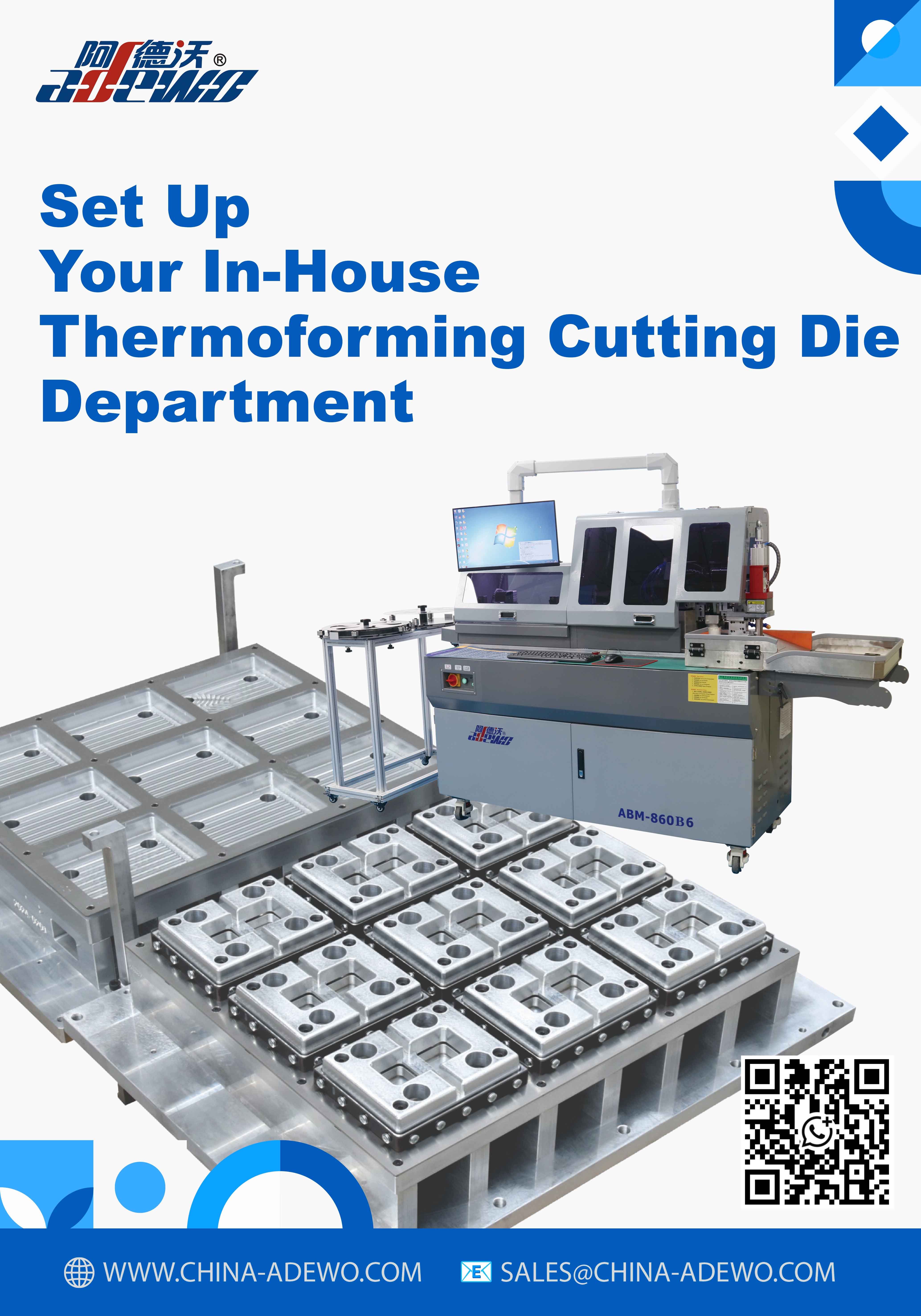
In the world of thermoforming, mold base material isn't just a technical detail—it shapes how quickly you can iterate, how long your tooling lasts, and how your bottom line shifts over a production run. Chinese manufacturers have spent years refining both aluminum and steel options, but the real conversation starts with what you're actually forming and how many cycles you expect. Aluminum, for instance, tends to shine when you need to move fast: a prototype mold base machined from 6061 or 7075 aluminum can be cut and polished in days, not weeks, which matters when a client is still tweaking part geometry. Steel, on the other hand, often feels like the long-game choice—P20 or S50C tool steels can take a beating cycle after cycle without losing flatness or dimensional stability, but the upfront machining time and cost are noticeably higher.
What makes Chinese thermoforming suppliers different is how they blend local material sourcing with practical heat treatment. You'll find shops that use A7075 aluminum for vacuum forming molds that won't exceed a few thousand pulls, especially for packaging trays or shallow draws where thermal conductivity helps the sheet cool faster and cycle times drop. But when the application shifts to heavy-gauge forming—think automotive interior panels, appliance liners, or durable industrial housings—steel becomes almost non-negotiable. The clamping pressures and repeated heating cycles on a 10mm-thick sheet will soften and warp unhardened aluminum over time, leading to inconsistent draw ratios and more scrap. Many experienced Chinese mold base builders will recommend a steel base with aluminum inserts as a middle path, keeping the structural frame rigid while allowing quick changeovers for cavity details.
Beyond mechanical properties, there's the matter of surface finish and maintenance. Steel bases take well to polishing and plating, so if you're running food-contact packaging or parts with visible grain patterns, steel holds a mirror finish longer. Aluminum, even with anodizing, tends to show wear faster on high-friction areas like plug assists or trim edges. But aluminum's lighter weight also means easier handling and less machine wear, which is something smaller Chinese mold shops exploit to keep their overhead low. Ultimately, the choice isn't about which material is "better"—it's about matching the metal to the expected cycle count, sheet thickness, and how tolerant your process is of gradual tool drift. Ask a seasoned thermoforming engineer in Shenzhen or Ningbo, and they'll likely tell you: start with aluminum for development, switch to steel once the part design freezes and volumes climb past a few thousand units.
Cooling Channel Layouts That Actually Shorten Cycle Times
Most cycle time problems aren't cooling capacity problems—they're routing problems. A straight drilled channel under a deep rib leaves a pocket of stagnant coolant, so the rib stays hot while the surrounding steel cools. Moving that channel up into the rib, or adding a baffle to force flow to the tip, often removes seconds from the cycle. The same logic applies to bosses and slide pockets: if coolant doesn't reach the steel that touches the hottest plastic, you're waiting on a spot that never gets cold.
Conformal layouts can follow the part surface within a few millimeters, but you don't always need metal 3D printing. A spiral channel cut into a core insert, or a series of interlocking plates with milled half-round grooves, can deliver the same effect. What matters is coverage and balanced resistance. One overly long loop with high pressure drop will starve parallel loops, so the mold still cools unevenly. Design the network like an electrical circuit—equal resistance per branch, enough flow to hit turbulent velocity, and no dead ends.
When you shorten the heat path and balance the flow, ejection temperature arrives sooner everywhere at once. You can pull parts earlier without sinks, warpage, or blush. Depending on wall thickness and material, cycle time drops of 10–25% are realistic just from rearranging channels you were already going to drill. The best layouts don't just add more cooling—they remove the wait.
EDM and Wire Cutting for Complex Thermoforming Die Geometries
Complex thermoforming dies often include deep cavities, sharp internal corners, and textured surfaces that conventional milling cannot reach cleanly. EDM handles these features by using a shaped electrode to erode hardened tool steel without contact, allowing blind ribs, narrow slots, and fine grain patterns to be produced directly in the cavity. Because the electrode can be machined from graphite or copper in stages, it also permits undercuts and intricate draft details that would otherwise require splitting the die into multiple pieces.
Wire cutting complements this by producing precise through-profiles and tight-tolerance openings for ejector pins, trim edges, and alignment features. Since the wire never touches the workpiece and the process is largely thermal, there is no cutting force to distort thin walls or leave burrs. This makes it practical to cut hardened inserts, punch plates, or full die contours after heat treatment, keeping dimensions stable across the entire forming surface.
Used together, EDM and wire cutting allow a thermoforming die to be built as a single hardened block or as a small set of inserts with near-zero clearance. The result is a die that holds sharper vacuum hole patterns, smoother draw radii, and more repeatable part wall thickness, while reducing the hand fitting and polishing normally required after milling.
CAD/CAM Integration from Prototype to Production in Chinese Toolrooms
In Chinese toolrooms, CAD/CAM integration is rarely just about installing a software suite. Engineers tend to lock down machining datums and parting surfaces while still in the design phase, so the prototype's surface data flows into CAM without rework. That early alignment means a change to the prototype can often trigger a toolpath update in minutes rather than days.
Moving from prototype to production shifts the focus from speed to repeatability. The same master model drives both quick one-off cuts and volume programming, but most shops keep separate parameter sets for production—tighter tolerances, adjusted feeds, and more conservative stepovers. The parametric link is useful, yet experienced programmers still verify critical fillets and shut-off edges by hand instead of trusting a blanket regenerate.
A number of toolrooms in China have built modular fixturing and standardized tool libraries around this integration, which cuts setup time significantly. The cutting data collected during prototype iterations gets folded back into CAM templates, so the next similar part reaches stable production faster. This loop isn't rolled out in a single project; it grows through repeated jobs and small refinements.
Hard Coatings and Surface Treatments That Extend Die Life
Tooling failures rarely announce themselves in advance. Instead, surfaces degrade by inches—microcracks widen, edges soften, and the die's geometry drifts until scrap rates climb and downtime becomes a rhythm. Hard coatings like titanium nitride, chromium nitride, and diamond-like carbon address this by creating a dense, low-friction barrier between the die and the material being formed. The result isn't just longer life, but a more predictable one, where wear patterns shift from sudden failure to gradual, measurable change.
Surface treatments such as nitriding, boriding, and laser texturing take a different path. Rather than adding a separate layer, they modify the die surface itself, hardening the outermost microns or patterning them to retain lubricant and control metal flow. For stamping, forging, and high-pressure die casting, this can reduce galling and soldering, the two culprits that quietly eat away at tool investment. The choice between coating and treatment isn't universal; it hinges on operating temperature, contact stress, and whether the die sees abrasive wear or adhesive pickup.
What gets overlooked is how these technologies compound. A nitrided substrate under a PVD coating often outperforms either alone, because the diffusion layer supports the hard film and prevents it from collapsing under load. Proper edge preparation and surface finish before treatment matter just as much as the treatment itself. Shops that treat die life as a systems problem—matching coating chemistry, substrate preparation, and post-treatment polishing—routinely see two to five times more parts per tool, without adding a single minute to cycle time.
FAQ
Chinese builders increasingly combine five-axis machining with in-house thermal compensation, which keeps die cavities stable across long production runs. Many shops also pair CNC finishing with manual benchmarking to hold tolerances under 0.02 mm on complex packaging molds.
High-speed three-axis and five-axis milling handle most cavity work, while wire EDM is reserved for sharp corners and deep ribs that rotating tools cannot reach cleanly. Some plants add laser texturing after heat treatment to create grip patterns or brand details without affecting dimensional accuracy.
Modern dies often include conformal cooling channels placed close to the forming surface, which shortens cycle times and reduces warpage in thin-gauge parts. Temperature-controlled water manifolds and separate zones for the plug assist area are common, especially for polypropylene and PET applications.
A polished cavity reduces sticking and makes demolding more consistent, while a measured roughness helps certain materials release correctly. Many Chinese tool rooms use diamond paste finishing followed by hard chrome or nickel plating to protect against abrasive fillers and cleaning chemicals.
Sheet thinning prediction and plug-assist motion studies let engineers correct draw ratios before steel is cut. This reduces trial runs and allows smaller workshops to quote complex packaging jobs with more confidence, since simulated wall thickness closely matches first-article results.
Aluminum alloys such as 7075 are popular for prototype and short-run tools because they machine quickly and conduct heat well. For high-volume production, P20 and stainless tool steels are preferred for their wear resistance, especially when forming filled or recycled materials.
Export-focused builders tend to use modular base plates and standardized ejector systems to lower assembly costs while keeping cavity inserts precision-ground. They also run geometric inspection reports on every die, which gives overseas buyers measurable confidence without pushing the price to European levels.
More shops are adopting automated electrode changing and probing systems so a single machinist can supervise multiple machines overnight. There is also a clear move toward closed-loop mold temperature monitoring, where sensors feed data back to the thermoforming line and adjust heating zones in real time.
Conclusion
Five-axis machining has quietly changed how Chinese toolrooms approach thermoforming die accuracy, letting them cut complex contours in a single setup instead of juggling multiple fixtures. That shift matters because any misalignment between setups shows up directly as surface defects on formed parts. Pair that with the ongoing aluminum versus steel debate for mold bases: many shops now choose aluminum for faster heat transfer and easier machining on prototype runs, while steel remains the go-to when production volumes demand resistance to wear and dimensional stability over thousands of cycles. Cooling channel layouts sit at the heart of cycle time reduction, and the real insight is that conformal channels—placed close to the cavity surface rather than in straight lines—often cut cooling time more effectively than simply increasing water flow.
For complex die geometries, EDM and wire cutting fill the gap where conventional milling cannot reach deep corners or fine ribs, especially in hardened tool steels. What separates capable Chinese toolrooms is not just having these machines but sequencing them properly after rough machining and before heat treatment. CAD/CAM integration ties the whole process together, from prototype iteration to production, allowing adjustments in the digital model to ripple through toolpaths without manual rework. Finally, hard coatings and surface treatments—nitriding, PVD coatings like TiAlN, or diamond-like carbon—extend die life by reducing friction and protecting against abrasion from filled or recycled thermoforming materials. These treatments are not afterthoughts; they are applied selectively to high-wear areas after geometry is proven, which keeps costs down while pushing die longevity well beyond bare steel or aluminum.
Contact Us
Contact Person: KAELYN LEE
Email: [email protected]
Tel/WhatsApp: +86 15012673758
Website: https://www.china-adewo.com