

China Centrifugal Air Compressor Technology: Key Advancements and Market Insights
2026-11-02
China's centrifugal air compressor market is evolving faster than many realize, driven by breakthroughs in efficiency, smart controls, and energy recovery. While global players have long dominated, a wave of domestic innovation is reshaping the competitive landscape—and end users are paying attention. In this article, we break down the key technological advancements and market shifts, offering insights that matter for anyone investing in compressed air systems. As these developments unfold, companies like Seize Air are positioning themselves at the forefront, turning engineering progress into real-world reliability.
Beyond the Screw: Why Centrifugal Designs Are Taking Over China's Air Compression
For decades the rotary screw compressor ruled Chinese factory floors, prized for its moderate first cost and tolerable efficiency at smaller scales. But as plants expand and energy prices climb, the calculus is shifting. Centrifugal machines operate on a fundamentally different principle—accelerating air through impellers rather than trapping it between rotating lobes—and that difference becomes decisive above roughly 150 kilowatts. A single centrifugal unit can deliver the same volume as several screws while drawing noticeably less current, which matters when a production line runs around the clock.
Maintenance is another quiet driver. Screw compressors demand regular attention to airend clearances, oil separation, and bearing wear; skip a cycle and performance degrades fast. Centrifugal designs have fewer rubbing parts in the compression path and, in many configurations, no lubricant touching the air at all. That translates into longer uninterrupted stretches between service intervals and a cleaner air supply for sensitive processes like electronics fabrication or pharmaceutical coating. Chinese manufacturers have also become adept at producing the precision cast impellers and high-speed motors locally, narrowing the price gap that once kept centrifugal options out of reach for mid-sized operations.
The shift isn't about a single breakthrough but a convergence of pressures: stricter emissions and efficiency targets, growing demand for oil-free air in export-oriented industries, and a domestic supply chain mature enough to offer competitive lead times. Where a decade ago centrifugal compressors were confined to mega-projects and refinery-scale installations, they now appear in textile mills, auto parts plants, and even district cooling stations. Screw technology won't disappear—it still owns the low end and variable-demand niches—but the center of gravity for large, steady-load air systems in China has clearly moved beyond the screw.
Magnetic Bearings and the Silent Leap in Energy Efficiency
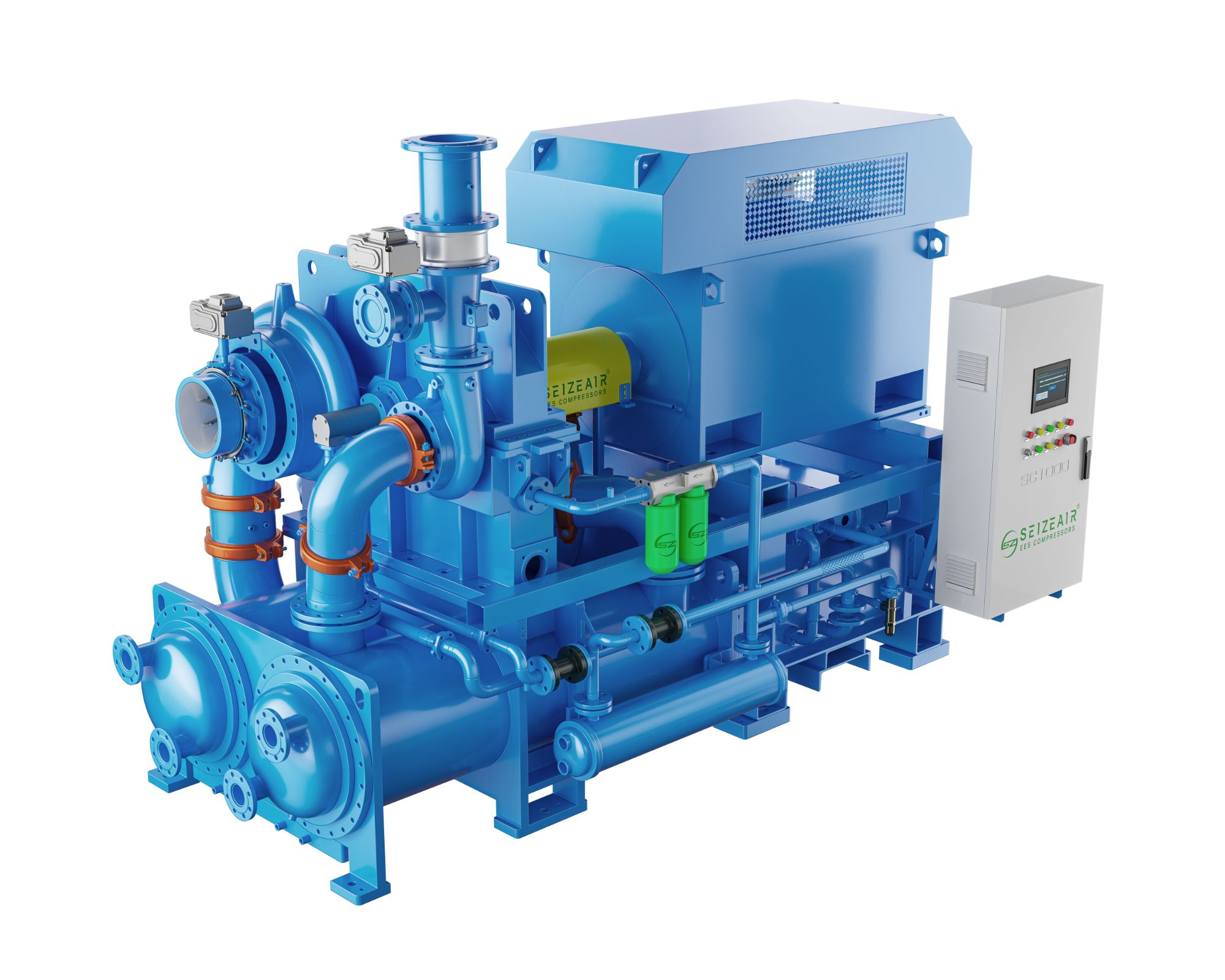
Walk into a compressor station running on magnetic bearings and the first thing you notice is what's missing: the low rumble of metal rolling against metal. These bearings levitate the rotor with controlled electromagnetic fields, so there is no physical contact and no oil film to shear. The energy that used to bleed away as frictional heat and vibration now stays in the drivetrain, doing useful work instead of warming the housing.
The efficiency leap comes from eliminating parasitic losses rather than bolting on extra stages. Active magnetic bearings use position sensors and fast control loops to hold the shaft within micrometers, drawing only a small amount of power for the electromagnets. In high-speed applications like flywheel energy storage and turbo expanders, the difference shows up as lower amp draw, cooler operation, and much longer service intervals. The silence is not an added feature; it is the sound of mechanical drag being removed from the equation.
From Chip Fabs to Hydrogen: New Applications Reshape Demand
Semiconductor fabs used to order high-purity gases on steady, predictable cycles. That changed once advanced-node construction accelerated in Arizona, Texas, Dresden, and Kumamoto. Nitrogen trifluoride demand now spikes when chamber-cleaning tools are qualified, while tungsten hexafluoride orders bunch around new deposition line starts. Suppliers are responding by placing buffer stock much closer to fab sites, sometimes inside customer-owned logistics hubs, because a single delayed cylinder can idle a lithography cluster for hours.
Hydrogen demand is developing along a different path. Instead of large refinery or ammonia contracts, the newer requests come from electrolyzer manufacturers running test stacks, fuel-cell bus depots adding nighttime refueling, and utilities blending hydrogen into peaking turbines. These buyers often want modular, on-site production or tube-trailer deliveries with much shorter lead times. The volumes are small today, but the geographic scatter is forcing distributors to rethink route density and compressor sizing.
What ties the two markets together is the purification and safety infrastructure. The same trace-moisture and particle controls used in chip fabs show up in electrolyzer balance-of-plant specs. Gas companies that can move specialty chemicals into a cleanroom on Monday and commission a hydrogen skid on Thursday are capturing orders that traditional bulk suppliers miss. Demand planning is becoming less about any single gas and more about managing a portfolio of molecules across very different industrial rhythms.
The Policy Push Behind Higher-Efficiency Compressors
Regulators in several key markets have moved beyond voluntary efficiency targets, setting mandatory minimum isentropic efficiency levels that directly shape compressor design. In the EU, the revised Ecodesign framework now covers a wider range of rotary and reciprocating units, forcing manufacturers to abandon older motor and airend combinations almost overnight. Meanwhile, China’s latest GB standards raise the bar for variable-speed machines, and states like California tie utility rebates to performance thresholds that were considered premium just five years ago.
This regulatory momentum has compressed development timelines in a way that market demand alone never did. Engineering teams now start with the compliance envelope and work backward, selecting rotor profiles, drive trains, and cooling strategies that clear the new efficiency floors without sacrificing turndown or reliability. The result is a quiet wave of redesigns: smaller oil-injected screws with permanent magnet motors, two-stage compression for applications that once used single-stage, and wider use of heat recovery as a standard feature rather than an option.
Perhaps most telling is how policy has begun to reward measured performance rather than catalog ratings. Part-load efficiency, seasonal energy efficiency ratios, and even leak-audit requirements are appearing in incentive programs, pushing users and service providers to optimize entire systems rather than swap out a single component. For compressor makers, the pressure now comes not only from factory inspectors but from energy managers who read the fine print of local building codes and carbon reporting rules.
Local Players Move Upmarket, Challenging Global Incumbents
For years, local manufacturers in emerging markets were pigeonholed as budget alternatives, focusing on cost-sensitive buyers and leaving premium segments to established global brands. But that narrative is shifting quickly. Companies that once built their reputation on affordability are now investing heavily in R&D, upgrading production facilities, and recruiting top design talent to compete in the mid-to-high-end space. They are not just copying foreign models anymore; they are tailoring products to local tastes with higher-grade materials, smarter features, and more refined aesthetics.
This move upmarket is creating real pressure on global incumbents who previously enjoyed comfortable margins without serious domestic competition. Local players understand regional consumer behavior deeply—how climate, infrastructure, and cultural preferences shape buying decisions—and they are turning that insight into a competitive edge. From automotive and electronics to home appliances and personal care, these challengers are launching flagship product lines that rival the quality and performance of international heavyweights, often at a more accessible price point. Some have even started exporting their premium offerings, flipping the old dynamic on its head.
The shift is not without obstacles. Building a premium brand image takes years, and local companies must overcome lingering perceptions of inferior quality. Yet early indicators suggest that a growing number of consumers are willing to give homegrown brands a chance in the upper tier, especially when they see tangible improvements in design, durability, and after-sales service. If this trend continues, global incumbents will have to rethink their strategies—either by doubling down on innovation and brand loyalty or by finding ways to collaborate with the very local players they once dismissed.
Smart Controls and Predictive Maintenance as the Next Frontier
The shift toward smart controls and predictive maintenance represents more than a technical upgrade—it signals a fundamental change in how industrial systems are understood and operated. Traditional maintenance cycles, rooted in fixed schedules or reactive repairs, often waste resources or let small faults grow unnoticed. Smart controls, by contrast, embed sensing and computation directly into the operational loop, allowing machines to adjust their own parameters in real time. When these controls are paired with predictive models that learn from historical data, the result is a system that doesn't just respond to breakdowns but actively works to prevent them.
One of the quiet revolutions here is the move from threshold-based alerts to probabilistic forecasting. Instead of triggering maintenance after a vibration exceeds a preset limit, modern approaches model the remaining useful life of a component under varying loads and environmental conditions. This means maintenance can be scheduled during planned downtime, spare parts can be ordered before they are urgently needed, and production lines can run closer to their true capacity without risking catastrophic failure. The real frontier lies in making these predictions robust across different machines, factories, and even industries—not just tuned to a single well-instrumented asset.
What often gets less attention is the role of human expertise in this transition. Smart systems generate enormous streams of data, but turning that data into reliable action requires deep domain knowledge about failure modes and operational trade-offs. The most successful deployments pair algorithmic insights with the tacit knowledge of experienced technicians, creating a feedback loop where models are continuously refined by on-the-ground reality. As sensors become cheaper and edge computing more capable, the frontier will likely shift from installing predictive capabilities on flagship equipment to making them standard across entire fleets—democratizing the benefits of early fault detection and adaptive control.
FAQ
Chinese manufacturers have moved from copying foreign designs to developing high-speed permanent magnet motors, active magnetic bearings, and advanced impeller aerodynamics. The shift toward oil-free designs with integrated variable frequency drives has boosted efficiency by 10-15% compared to older fixed-speed units, while digital controls now allow real-time performance monitoring through industrial IoT platforms.
Electronics and semiconductor fabrication, pharmaceuticals, food and beverage, and automotive painting lines are the strongest buyers because they require completely oil-free air. The petrochemical and power generation sectors also remain significant, but their purchasing cycles are longer and more tied to large infrastructure projects.
China's minimum energy performance standards and the double carbon targets have pushed compressor makers to abandon outdated models. Subsidies and green factory incentives reward plants that install first-class efficiency machines, which has accelerated the replacement of older screw and reciprocating units with high-end centrifugal systems.
In the 100-500 kW range, yes. Domestic companies have closed the gap in core components such as high-speed motors and controllers, often offering 20-30% lower prices with comparable reliability. However, for ultra-large or extreme-condition applications, brands like Atlas Copco and Ingersoll Rand still hold an advantage in long-term field data and global service networks.
Magnetic bearings eliminate mechanical contact, which removes the need for oil lubrication and reduces maintenance intervals dramatically. For industries like biopharma and electronics, where even trace oil contamination ruins batches, this technology is becoming the default choice. Chinese firms have also reduced the cost of magnetic bearing controllers by localizing power electronics.
Many now embed sensors for vibration, temperature, and pressure that feed into cloud-based analytics. Predictive maintenance algorithms alert users weeks before a bearing or impeller issue would cause downtime. This compressor-as-a-service model is gaining traction, especially among smaller factories that want to avoid large upfront capital spending.
The main hurdles are oversupply in the low-end segment, price wars that squeeze R&D budgets, and trade restrictions on rare-earth magnets used in high-speed motors. Additionally, the real estate slowdown has reduced demand from construction-related manufacturing, forcing companies to diversify into export markets.
Expect breakthroughs in two-stage compression with intercooling at smaller sizes, wider use of silicon carbide power electronics for higher motor speeds, and integration with renewable energy microgrids. Some Chinese research institutes are also testing compressor designs that use CO2 as a refrigerant, which could open up new industrial heat pump applications.
Conclusion
China's compressed air sector is undergoing a decisive shift away from traditional screw machines toward centrifugal designs, driven by a convergence of stricter energy policies, advanced magnetic bearing technology, and rapidly evolving end-user demands. Magnetic bearings eliminate contact friction, allowing high-speed rotors to achieve unprecedented efficiency gains while also reducing noise and maintenance needs—a silent leap that aligns with Beijing's push for higher-efficiency industrial equipment. New applications in semiconductor fabrication, hydrogen refueling stations, and precision manufacturing are reshaping demand patterns, as these sectors require ultra-clean, oil-free air with tight pressure control.
Domestic manufacturers are rapidly moving upmarket, investing in proprietary impeller designs, high-speed motors, and smart control systems that challenge established global players on both performance and cost. The integration of IoT-enabled predictive maintenance has become a critical differentiator, allowing operators to monitor bearing health, vibration signatures, and aerodynamic performance in real time. As local firms master these technologies and policy incentives continue to favor energy-efficient equipment, centrifugal compressors are poised to become the default choice for large-scale industrial air supply across China's most demanding industries.
Contact Us
Contact Person: Mia
Email: [email protected]
Tel/WhatsApp: +86 19821985894
Website: https://www.seize-air.com