

Best Industrial Sectional Door Options for Heavy-Duty Facilities
2026-08-28
A single stalled bay door can idle an entire shift. Heavy-duty facilities don’t just need a door that opens and closes—they need one that survives forklift hits, extreme temperature swings, and thousands of cycles a month without turning maintenance into a full-time job. That’s why we looked past basic spec sheets to find the best industrial sectional door options for heavy-duty facilities. The list includes NORTON, a brand that keeps showing up in high-abuse loading docks and production bays. Before you spec another replacement, here’s what actually holds up.
When Forklifts Meet Doors: Surviving Daily Impacts
Warehouse doors take a beating that most building components never have to endure. A forklift backing out with a full pallet, a driver misjudging the turn radius, or a hurried shift change can send thousands of pounds of steel and cargo straight into the door guides, panels, or tracks. Most damage doesn't come from a single catastrophic hit—it accumulates through dozens of small knocks every week, bending bottom bars, loosening hinges, and cracking panels until the door finally gives out exactly when you need it most.
The difference between a door that survives and one that fails is rarely the material thickness alone. It's how the door handles that sideways push and sudden shock. Rigid doors transfer force directly to their weakest points; impactable doors shed energy by flexing and popping back into place. Look for designs with breakaway bottom edges, reinforced guides, and track systems that let a panel swing out on impact rather than crumple in place. Even the most robust door benefits from visual cues—high-visibility stripes, floor markings, and approach lighting—that help operators correct before contact happens.
Maintenance teams often learn the hard way that replacing a bent panel isn't enough. After every hit, the real question is whether the door's alignment, spring tension, and guide clearance are still within spec. A door that looks fine but has shifted by half an inch will start grinding on the next cycle, wearing out rollers and creating the exact conditions for a worse collision later. Scheduling a quick post-impact inspection—especially after a known hard hit—keeps small repairs cheap and keeps the door in service through the daily grind.
Thermal Seals That Actually Hold Up in Unheated Bays
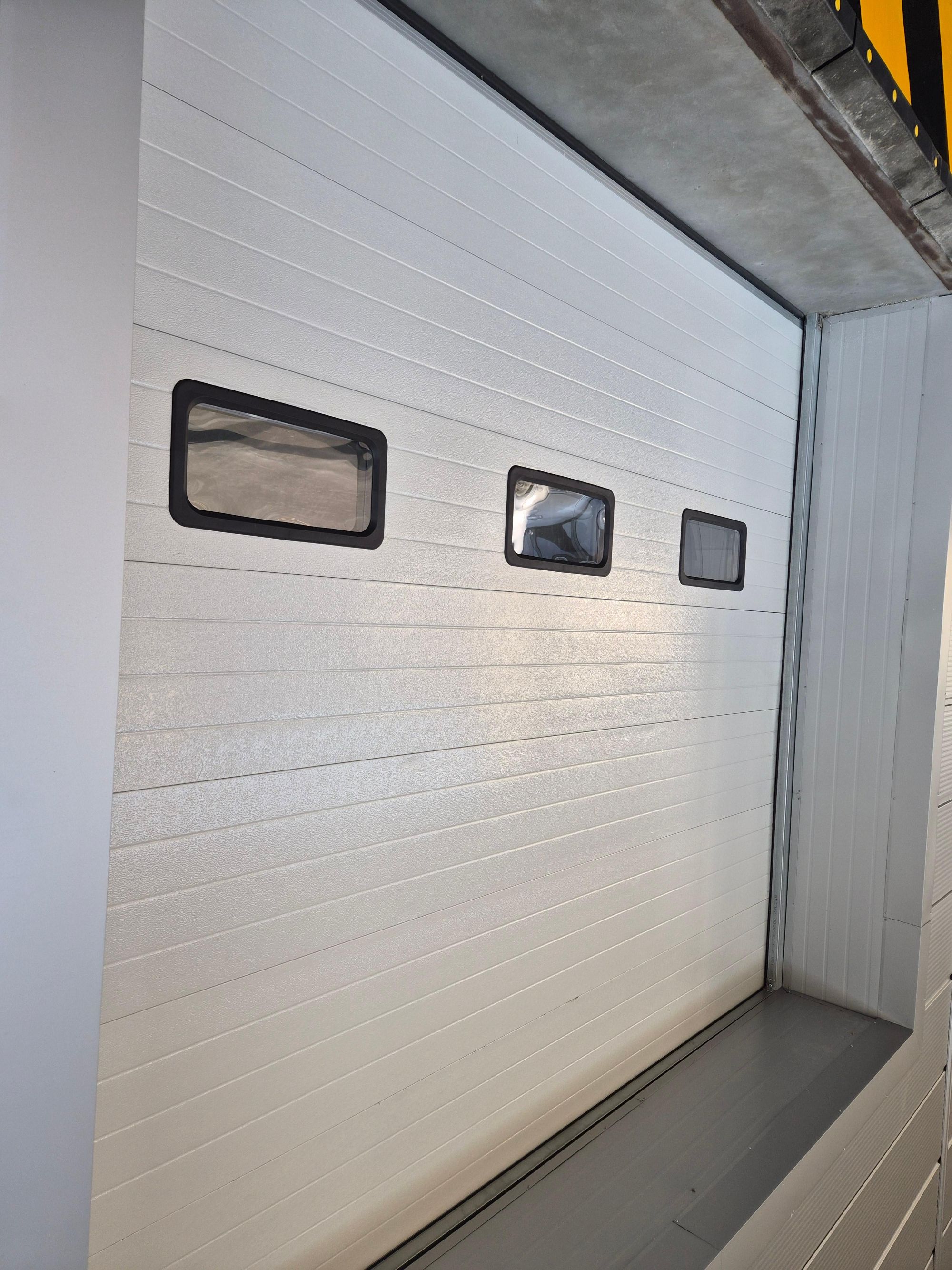
In an unheated bay, the enemy isn't just cold air—it's the constant cycle of compression, frost, and mechanical abuse from lift trucks and pallets. Most seals sold for this job are designed for conditioned spaces, so they harden once temperatures drop and then crack along the hinge line. A seal that will hold up needs a core that stays flexible below zero and an outer jacket that doesn't turn brittle when the wind howls through the gap.
Look for closed-cell EPDM or silicone blends rather than generic PVC. EPDM retains its rebound after years of being crushed by trailer bumpers, and it won't take a set the way cheap foam does. The mounting hardware matters just as much—galvanized or stainless retainers prevent the rust streaks that eat through aluminum tracks in damp, unheated conditions. If the bay floor sees salt or calcium chloride, that's another reason to skip bare steel.
Installation is where most thermal seals fail early. A seal that's pinched too tight against an uneven concrete header will wear through in one season. Give it enough compression to seal, but leave room for the door panel to move. On docks with frequent trailer movement, add a brush or wiper strip on the outer face to knock off ice before it gets dragged into the seal. That little detail can double the life of the main thermal barrier.
Security Layers Beyond the Lock: What Heavy-Duty Really Means
A heavy-duty lock does more than snap shut—it layers resistance into every point a thief might think to test. The shackle isn't just thicker; it's often formed from boron alloy or case-hardened steel that laughs off bolt cutters, while the body hides a double-ball bearing locking mechanism that keeps the shackle seated even after the outer casing takes a beating. Rubber or vinyl cladding isn't there for looks. It shields the lock from rain, road salt, and UV damage, so the parts inside don't corrode into weakness.
That outer armor only matters if the keyway refuses to be a shortcut. High-pin cylinders, anti-pick mushroom pins, and restricted key blanks force someone to spend far longer than they planned, and most will walk away before that effort pays off. On jobsites and storage yards, the real heavy-duty standard shows up in stupid-simple details: a drain hole that lets water out before it freezes, a shackle that rotates so a prying bar can't find a pivot, and a body that can take a hammer without cracking where the plating thins. None of this is loud. It's just built so the lock isn't the weak link in the chain.
Oversized Openings Without the Sag or Slop
Wide openings fail slowly. A header that clears code minimum still deflects enough to pinch a door or crack a corner bead. The hinge side drops a sixteenth, then an eighth, and soon the reveal tapers like a bad haircut. Most sag and slop traces back to three weak links: undersized headers, hinge leaves that wear under constant load, and missing shear transfer at the corners. Fix those and the opening stays square.
Specify the header like a beam, not a board. Engineered lumber or a flitch plate can carry the span with a deflection limit of L/480 or tighter, which keeps drywall and glazing from fighting the frame. At each jamb, run double or triple studs and install squash blocks so the point load doesn't crush the top plate. For doors or window walls, use continuous hinges with sealed bearings and set the pivot points on steel plates. Screws into end grain are temporary; through-bolts are permanent.
Rough openings need the same tolerance as finish carpentry. Leave shim space at the sill, and level the subfloor with a laser instead of a spirit level. After hanging the unit, cycle the panel full travel five or six times before trimming. If the gap stays parallel and the latch line doesn't drift, you've got an oversized opening without the sag or slop. It should feel heavy when it moves—not sloppy, just deliberate.
Why Cheap Tracks Cost More by Year Three
At first, the math seems simple: pay less for a set of tracks and pocket the difference. But by year three, that initial discount has quietly turned into a repair bill that makes you wince. Bargain tracks tend to stretch, wear unevenly, and lose their pin-and-bushing integrity much faster than expected. You end up replacing individual links, then paying for labor again and again, until the whole assembly gives out around the third season. The machine spends more time in the shop than on the job, and that downtime isn't free.
Cheap tracks also drag down the rest of the undercarriage. Soft alloys and skipped heat treatment mean the rails deform under load, which throws off the pitch and puts extra stress on sprockets, rollers, and idlers. Those components are not cheap to swap either. By the time you finally buy a quality set, you've paid for the bargain tracks, two rounds of patch repairs, and a damaged drive system. A good track built to last three or more years keeps everything aligned, so the real cost per hour stays low. The cheap option just becomes a recurring expense that quietly eats your margin.
Serviceability: The Maintenance Factor Nobody Puts in the Brochure
Walk around any equipment yard and you'll see machines that look identical on paper. Same horsepower, same lift capacity, same fuel burn. But put a wrench in your hand six months later and the differences start screaming. Serviceability isn't a spec you can print on a glossy sheet — it's how many curse words you'll mutter when you realize the oil filter sits behind a hydraulic line that requires three extensions and a prayer to reach.
Manufacturers love to talk about uptime, but uptime starts the moment a technician opens the side panel. If the daily grease points are buried under a maze of hoses, you won't grease them. If the dipstick is hidden behind a bracket that needs a mirror and a flashlight, you'll skip the check. Real serviceability means a 15-minute daily inspection actually takes 15 minutes — not 45 with a bloodied knuckle as the souvenir.
Next time you compare two machines, ignore the brochure's promises. Open the engine bay. Crawl underneath. Ask the mechanic, not the salesperson, which one they'd rather work on at 5 a.m. on a January morning. The answer will tell you more about your true cost of ownership than any fuel-efficiency chart ever could.
FAQ
Focus on cycle rating and panel reinforcement before aesthetics. A door that's rated for 100,000+ cycles with continuous hinges and heavy-gauge steel will survive the constant opening and closing at loading docks far better than a standard commercial door. Also check the track design—3-inch tracks with ball-bearing rollers handle vibration and impact much better than 2-inch residential-style tracks.
Lower gauge numbers mean thicker steel, but thickness alone isn't everything. A 20-gauge door with internal ribbing can outperform a flat 18-gauge panel in impact resistance because the ribs act as structural beams. However, for facilities where forklifts regularly hit the bottom section, specifying a reinforced bottom panel with galvanized steel is often more important than chasing the thickest gauge across the entire door.
Insulation still pays off in most heavy-duty settings, even if you're not heating or cooling the space. Polystyrene or polyurethane cores add rigidity and reduce noise, which matters in busy plants. They also make the door lighter than solid steel but stiffer than non-insulated panels—so you get better cycle life and less sagging without switching to a heavier door that wears out springs faster.
Demand photo-eye sensors that auto-reverse if a forklift or worker crosses the threshold, plus a mechanical edge sensor on the bottom bar as backup. Break-away bottom sections are worth every penny in forklift-heavy environments—they release on impact and can be reattached in minutes instead of knocking the whole door off its tracks. Also insist on through-shaft spring containment so a broken torsion spring can't fly off and cause injury.
Keep replacement panels, rollers, hinges, and a spare spring set in stock—ideally the same model as your existing doors. If a section gets hit, you can swap just that panel in under two hours with a lift and two technicians. For facilities with multiple identical doors, standardizing brands and sizes means you can cannibalize parts from a less-critical opening during an emergency rather than waiting days for shipping.
Standard torsion springs are rated for about 10,000 cycles, which sounds like a lot until a busy dock cycles a door 50–100 times per day—that's a spring failure every few months. High-cycle springs rated for 100,000 or even 250,000 cycles cost 20–30% more upfront but last years instead of months under constant use. Pair them with a gear-reduction operator, and you also reduce motor strain and door slamming at end of travel.
Yes, but it's not just about ordering a custom size. Low-headroom kits use double horizontal tracks and special cable drums to tuck the door tighter to the ceiling, but you lose a few inches of vertical clearance when the door is open. For extra-wide openings, you may need a heavier shaft and additional center support brackets to prevent deflection. Always have the installer measure the actual opening and the available side room—many odd-sized jobs fail because there wasn't enough lateral space for the track radius.
Wind load ratings are the difference between a door that holds and one that blows out during a storm, potentially causing roof damage. Look for doors tested to local building code standards, often requiring reinforced stiles, thicker tracks, and additional jamb anchors. If your facility is in a hurricane zone, consider a door with a static pressure rating of at least 20 psf and an impact-rated bottom section, not just a standard commercial model with a high wind load label.
Conclusion
In heavy-duty facilities, the sectional door is not a passive barrier—it is a piece of equipment that gets hit, pried, and thermally stressed every shift. When forklifts meet doors, the difference between a door that survives daily impacts and one that bends out of its guides comes down to reinforced panels, heavy-gauge end stiles, and impact-absorbing track systems. Thermal seals are another quiet failure point: in unheated bays, cheap bulb seals flatten and tear within months, while extruded EPDM or dual-durometer seals with thermal breaks keep their shape and actually hold up. For oversized openings, the real test is not the initial lift but how well the door resists sag and lateral drift after a few thousand cycles—look for double-reinforced top sections, continuous hinges, and counterbalance designs that account for wind load and uneven floor conditions.
Security in these settings goes far beyond a cylinder lock. Heavy-duty means nested steel skins, internal slide bolts, and optional interlocks that prevent the door from being forced open at the bottom corners. Track quality also separates serious industrial doors from residential-grade products: lighter zinc-plated tracks and cheap rollers will wear grooves and bind by year three, turning a “savings” into repeated service calls and door replacement. Finally, the maintenance factor nobody puts in the brochure—serviceability—matters most. Doors with bolt-on hinge replacements, accessible spring tensioning, and modular panel sections let a maintenance crew swap damaged parts in under an hour, rather than waiting days for a specialized technician. That operational uptime is what heavy-duty facilities actually pay for.
Contact Us
Contact Person: Cyril He
Email: [email protected]
Tel/WhatsApp: 8613969697307
Website: https://cqyqgd.en.alibaba.com/