

48m³ 7-Compartment Aluminum Alloy Bulk Feed Trailer Delivers Flexible and Efficient Feed Transport
2026-11-16
Moving feed in bulk usually means choosing between payload capacity and on-farm agility. The 48m³ 7-compartment aluminum alloy bulk feed trailer changes that equation. With seven separate compartments, it lets operators carry multiple feed formulations in a single trip without cross-contamination, while the aluminum construction keeps unladen weight low enough to make every axle work harder. For fleets looking to cut empty runs and improve delivery flexibility, KANGMU TRUCK has built this trailer around real loading and unloading routines, not just spec sheets. The result is a bulk feed transport solution that adapts to shifting ration requirements, tight farm entrances, and the daily pressure to do more with less. In this post, we take a close look at how its compartment layout, discharge system, and lightweight build come together for more efficient feed logistics.
Why Seven Separate Compartments Change the Way Feed Gets Delivered
Traditional feed carts and single-bin systems force every ingredient into the same space, so lighter grains settle, fines collect at the bottom, and the mix that reaches the bunk is never quite what was loaded. Seven separate compartments break that cycle before it starts. Each ration component stays in its own cell until the moment it is dispensed, which means particle size, moisture, and texture do not get a chance to migrate or compress. The result is less separation in transit and fewer refusals at the rail.
That separation also changes scheduling. Instead of making trips back to the commodity shed every time a different ration is needed, a loader can fill each compartment once and deliver several groups in one pass. Minerals, pellets, and long-stem hay keep their identity, so the operator can meter them out in the sequence the nutritionist intended. It feels like carrying seven small bins instead of one oversized box, and that makes the whole feeding routine faster without adding more horsepower or more labor.
How a 48 Cubic Meter Aluminum Body Keeps Payloads High and Corrosion Low
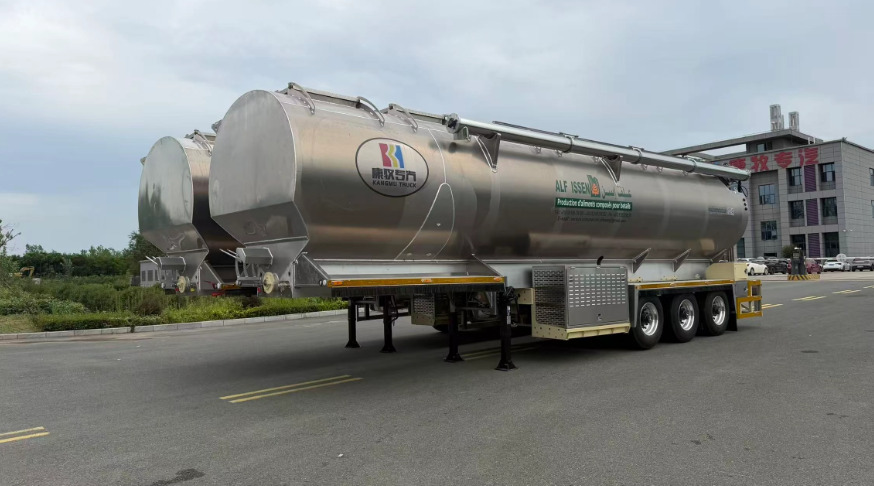
A 48 cubic meter aluminum body shifts the weight equation before the truck even moves. The shell itself weighs significantly less than a comparable steel unit, which means a larger share of the gross vehicle weight stays available for cargo. That extra allowance shows up as more drums, pallets, or bulk material per trip without pushing the chassis into overload territory.
The corrosion story is less about coatings and more about the metal's own behavior. Aluminum forms a thin, stable oxide skin the moment it is exposed to air. Scratches and small dents do not become rust points the way they would on steel, so the body keeps its structural integrity longer in wet, coastal, or chemically active environments.
On the maintenance side, that means fewer repaint cycles and less panel replacement over the life of the trailer. The 48 cubic meter capacity stays usable because the body is not quietly losing material to rust, and operators are not tying up equipment for corrosion repairs between loads.
What Operators Notice First About Towing This Trailer on Rural Roads
The first thing that stands out is how the trailer's track width lines up with the wheel ruts on older chip-seal roads. With narrow lanes and no real shoulder, the trailer tires tend to wander toward the edge when a loaded tractor or grain truck passes from the other direction. The suspension does a decent job of soaking up washboard sections, but you feel a slight sideways tug through the hitch whenever the passenger-side wheels drop off the pavement onto graded gravel.
Another early impression is the way it reacts during low-speed corrections. On tight curves with a crown in the middle, the trailer pushes just enough to make you widen the line more than expected. Braking into a downhill hairpin with a partial load produces a mild but noticeable rearward shove, so operators quickly learn to slow earlier and let the engine hold speed. The tall fenders also become a reference point when squeezing past mailboxes and bridge abutments, where the actual clearance feels tighter from the driver's seat than it looks in the mirrors.
Mixing Loads Without Cross-Contamination: A Closer Look at the Layout
The layout starts with a hard split between incoming materials, staging, and finished goods. Instead of relying on painted lines alone, facilities often use low walls, flexible curtains, or separate rooms for high-risk categories. Drainage slopes away from sensitive areas, and air handling is arranged so that dust or vapors from one bay do not drift into another. These barriers matter most at transfer points where a torn bag or spilled container can quickly become a source of contamination.
Equipment movement follows a one-way path, and dedicated tools stay within their assigned zones. Color-coded bins, pallets, and even cleaning equipment reduce the chance of someone borrowing a scoop from one area and returning it to another. Scheduling also plays a role: compatible products are grouped and processed back-to-back, while changeovers trigger a full cleanout rather than a quick sweep. This keeps the layout functional without requiring a separate building for every material.
The final check involves walking the floor with operators to spot awkward hand-offs, blind corners, and places where a cart might cross from a dirty zone into a clean one. Adjustments are often low-cost, such as repositioning a sanitizing station or adding a physical stop at a doorway. Over time, these small layout decisions reduce rework, protect product integrity, and make cross-contamination less dependent on individual attention.
Where Aluminum Alloy Construction Pays Off Over Years of Daily Use
Most materials show their age through rust, warped joints, or growing heft that makes every lift a little more tedious. Aluminum alloy tends to do the opposite in daily-use equipment such as carts, ramps, ladder frames, and mobile workstations. The payoff becomes clearest when a piece gets knocked around, rolled over uneven flooring, left in a damp garage, and still opens and closes without binding. That kind of tolerance is not just about dent resistance; it is also about how the alloy disperses stress across a joint instead of concentrating it near a weld or bend.
Over years, the lighter weight shifts how people actually use the item. A tool case that weighs eight pounds instead of twenty gets moved more often, which means it gets organized more often instead of being abandoned in a corner. The same applies to ramps and trolleys used by staff every shift. Less dead weight cuts the small repeated strains that accumulate into real injuries, and it often means one person can manage a task that would normally wait for a second set of hands.
There is also a quieter benefit with upkeep. Aluminum alloy does not need repainting to hide corrosion streaks, and it cleans with a wet cloth rather than a wire brush. Scratches look like scratches, not the start of structural rot. For anything that lives outside, gets wheeled through doorways, or earns its keep in a van, that adds up to more hours in service and fewer weekends spent repairing the tool instead of using it.
Turning Tight Delivery Schedules Into Manageable Runs
Tight delivery schedules usually fall apart because every stop is treated as equally urgent, and the resulting routes bounce drivers across the same neighborhoods multiple times. A simpler fix is to cluster stops by delivery windows and physical proximity before assigning vehicles. Even a ten-minute adjustment in one customer’s window can merge two short trips into one clean run, freeing up a driver for the next wave without adding miles.
Once the clusters are set, the focus moves to sequencing. Load the truck so the first stops are the ones with fixed receiving hours or limited dock access, then place flexible residential drops after those. Drivers gain back time when they are not reworking the back of the truck or waiting for a bay. It also helps to leave a small buffer between zones instead of stacking runs back-to-back, because real traffic and slow unloading will eat a perfect plan.
The final step is to make the run visible to everyone who depends on it. When dispatchers, drivers, and receiving teams see the same live sequence, a late return or a swapped stop becomes a quick adjustment rather than a chain reaction. Tight schedules do not have to mean chaotic days; they just need runs that respect distance, dock time, and driver stamina at the same time.
FAQ
Its seven separate compartments let operators carry different feed formulations in one trip without cross-contamination, so a single run can serve poultry, swine, or cattle customers instead of returning to the mill between loads.
Aluminum keeps the empty weight down, which means more payload can be carried legally. It also resists corrosion from moist feed and washdowns better than ordinary steel, and the lighter body reduces stress on tires, brakes, and suspension over time.
Seven compartments give much finer control over load planning. A driver can drop smaller quantities at multiple farms, adjust recipes between stops, and avoid wasting capacity when orders don't line up neatly into large bins.
Each compartment is independently discharged, so the operator can unload in a controlled sequence, handle partial deliveries, and switch product types without purging the whole system. The layout suits routes with several small drops rather than one large one.
Yes, it sits in a useful middle range. It offers enough volume to make rural routes economical, but remains maneuverable on narrower farm roads and lighter bridges where full-size walking-floor trailers can feel oversized.
Keep the seals and divider edges clean, because fine meal and pellet dust tend to pack into corners. Check air lines and gate controls regularly, and inspect the interior walls for wear around discharge openings. With aluminum shells, use compatible fasteners and repair materials to avoid galvanic corrosion.
Efficiency comes from fewer return trips, shorter loading and unloading times, and the ability to combine orders that would otherwise need separate vehicles. The independent compartments cut downtime because product changes happen at the discharge point rather than back at the feed mill.
Conclusion
The 48-cubic-meter aluminum alloy bulk feed trailer reworks daily delivery around one practical idea: loads do not have to travel together. Its seven separate compartments allow a single run to carry different rations or grain types while keeping each batch sealed off from the next, so a dairy mix, a finisher ration, and a custom blend can be dropped at separate stops without dragging a dedicated trailer for each. The aluminum body raises the useful payload by cutting dead weight, and the material shrugs off moisture and acidic feed residue that would steadily eat through steel. On narrow rural roads, the trailer tracks predictably instead of fighting the truck, which matters when gateways are tight, shoulders are soft, and every turn demands a stable, balanced load.
Inside the layout, dividers are positioned to make loading and discharge straightforward rather than forcing operators to climb and sweep between compartments. Cleanout is quick, and the risk of cross-contamination stays low even when switching between medicated feed and plain grain. Over years of daily use, the aluminum alloy construction holds its shape and resists the pitting that leads to leaks and costly repairs. The real payoff shows up in scheduling: a single unit can combine multiple small deliveries into one manageable route, cutting empty miles and reducing the pressure to rush between farms. Drivers spend less time repositioning and more time unloading, which turns a tight delivery window into a steady, controlled run.
Contact Us
Contact Person: Shen Zhikang
Email: [email protected]
Tel/WhatsApp: 8613908668969
Website: https://www.kangmutruck.com/